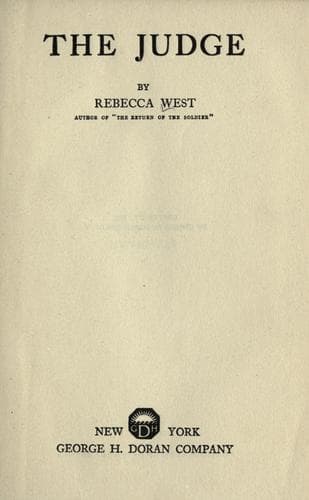
Scotland -- Social life and customs -- 19th century -- Fiction
She went and sat on a low stool by the fire, turning her face away from
him. So he was as little friendly as the rest of the world. Surely it
was plain enough that she lived in the extremity of destitution. The
only place that was hers was this drab little room with the shaking
walls and peeling chairs; the only person that belonged to her was her
mother, who was very dear but very old and grieving; and though
everybody else on earth seemed to have acquired a paradise on easy
terms, nobody would let her look in at theirs. It appeared that he was
just like the others. She folded her arms across her breast to compress
her swelling misery, while he sat there, cruelly not hurrying, and said
courteous things that afterwards repeated themselves in her ear all
night, each time a little louder, till by the dawn they had become
ringing proclamations of indifference.
Yaverland had turned on the doorstep as he left and told her that,
though he believed he had to motor-cycle to Glasgow the next day to see
one of his directors there, it was just possible there might be a
telephone message at his hotel telling him he need not do so; and he had
asked that if this were so might he spend the time with her instead.
Because of this she had lived all Sunday in the dread of his coming. Yet
very often she found herself arrested in the midst of some homely
action, letting some tap run on to inordinate splashings, some pot boil
to an explosion of flavoured fumes, because she was brooding with an
infatuated smile on his rich colours and rich ways, on the slouch by
which he dissembled the strength of his body, the slow speech by which
he dissembled the violence of his soul. But there returned at once her
hatred of him, and she would long to lay her hand in his confidingly as
if in friendship, and then drive her nails suddenly into his flesh, so
that she would make a fool of him as well as hurt him. At that she would
draw her cold hands across her hot brow, and wonder why she should think
so malignantly of one who had been so kind--so much kinder than anybody
else had ever been to her, although she had no claim upon him. Yet she
knew that no argument could alter the fixed opinion of her spirit that
Yaverland's kingly progress through the world, which a short time ago
she had watched with such a singing of the veins as she knew when she
saw lightning, was an insult to her lesser height, her contemned sex,
her obscurity. The chaos in herself amazed her. The glass showed her
that she was very pale, and she wondered if such pallor was a sign of
madness. "I will not go daft!" she whimpered, and began rubbing her
cheeks with her knuckles to bring back the colour; and saw among the
quiet reflected things the queer face, its features pulled every way
with derision, of Mr. Philip.
He said twangingly, "Ten minutes past nine, Miss Melville!"
Public-domain text, read in full here on John Shaqi.
Reviews
Reviews
No reviews yet
Be the first to share your thoughts on this work.
Elsewhere in the archive
Join the Discussion
Join the discussion
Sign in to leave a comment or review.
Sign InorCreate an account