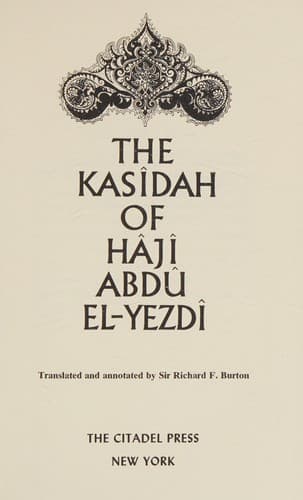
The Kasîdah of Hâjî Abdû El-YezdîBurton, Richard Francis, Sir
Philosophy
The Kasîdah of Hâjî Abdû El-Yezdî
Burton, Richard Francis, Sir
English poetry -- 19th century
He evidently holds to the doctrine of progress. With him
protoplasm is the Yliastron, the Prima Materies. Our word matter
is derived from the Sanskrit {Sanskrit} (mâtrâ), which, however,
signifies properly the invisible type of visible matter; in
modern language, the substance distinct from the sum of its
physical and chemical properties. Thus, Mâtrâ exists only in
thought, and is not recognizable by the action of the five
senses. His Chain of Being reminds us of Prof. Huxleys
Pedigree of the Horse, Orohippus, Mesohippus, Meiohippus,
Protohippus, Pleiohippus, and Equus. He has evidently heard of
modern biology, or Hylozoism, which holds its quarter-million
species of living beings, animal and vegetable, to be progressive
modifications of one great fundamental unity, an unity of
so-called mental faculties as well as of bodily structure. And
this is the jelly-speck. He scoffs at the popular idea that man
is the great central figure round which all things gyrate like
marionettes; in fact, the anthropocentric era of Draper, which,
strange to say, lives by the side of the telescope and the
microscope. As man is of recent origin, and may end at an early
epoch of the macrocosm, so before his birth all things revolved
round nothing, and may continue to do so after his death.
The Hâjî, who elsewhere denounces compound ignorance, holds
that all evil comes from error; and that all knowledge has been
developed by overthrowing error, the ordinary channel of human
thought. He ends this section with a great truth. There are
things which human Reason or Instinct matured, in its undeveloped
state, cannot master; but Reason is a Law to itself. Therefore we
are not bound to believe, or to attempt belief in, any thing
which is contrary or contradictory to Reason. Here he is
diametrically opposed to Rome, who says, Do not appeal to
History; that is private judgment. Do not appeal to Holy Writ;
that is heresy. Do not appeal to Reason; that is Rationalism.
He holds with the Patriarchs of Hebrew Holy Writ, that the
present life is all-sufficient for an intellectual (not a
sentimental) being; and, therefore, that there is no want of a
Heaven or a Hell. With far more contradiction the Western poet
sings:
Hell hath no limits, nor is circumscribed
In one self-place; but when we are in hell,
And where hell is there must we ever be,
And, to be short, when all this world dissolves,
And every creature shall be purified,
All places shall be hell which are not heaven.
For what want is there of a Hell when all are pure? He enlarges
upon the ancient Buddhist theory, that Happiness and Misery are
equally distributed among men and beasts; some enjoy much and
suffer much; others the reverse. Hence Diderot declares, Sober
passions produce only the commonplace . . . the man of moderate
passion lives and dies like a brute. And again we have the half
truth:
That the mark of rank in nature
Is capacity for pain.
Public-domain text, read in full here on John Shaqi.
Reviews
Reviews
No reviews yet
Be the first to share your thoughts on this work.
Join the Discussion
Join the discussion
Sign in to leave a comment or review.
Sign InorCreate an account