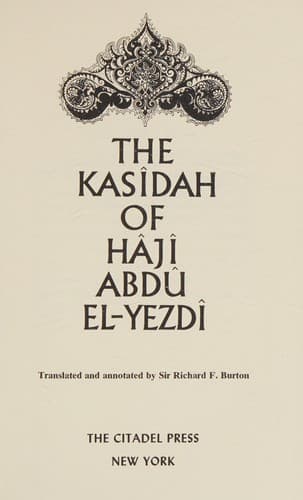
The Kasîdah of Hâjî Abdû El-YezdîBurton, Richard Francis, Sir
Philosophy
The Kasîdah of Hâjî Abdû El-Yezdî
Burton, Richard Francis, Sir
English poetry -- 19th century
We live our lives with rogues and fools,
dead and alive, alive and dead,
We die twixt one who feels the pulse
and one who frets and clouds the head:
And,oh, the Pity!hardly conned
the lesson comes its fatal term;
Fate bids us bundle up our books,
and bear them bodily to the worm:
Hardly we learn to wield the blade
before the wrist grows stiff and old;
Hardly we learn to ply the pen
ere Thought and Fancy faint with cold.
Hardly we find the path of love,
to sink the self, forget the I,
When sad suspicion grips the heart,
when Man, _the_ Man begins to die:
Hardly we scale the wisdom-heights,
and sight the Pisgah-scene around,
And breathe the breath of heavenly air,
and hear the Spheres harmonious sound;
When swift the Camel-rider spans
the howling waste, by Kismet sped,
And of his Magic Wand a wave
hurries the quick to join the dead.*
* Death in Arabia rides a Camel, not a pale horse.
How sore the burden, strange the strife;
how full of splendour, wonder, fear;
Life, atom of that Infinite Space
that stretcheth twixt the Here and There.
How Thought is impotent to divine
the secret which the gods defend,
The Why of birth and life and death,
that Isis-veil no hand may rend.
Eternal Morrows make our Day;
our _Is_ is aye _to be_ till when
Night closes in; tis all a dream,
and yet we die,and then and THEN?
And still the Weaver plies his loom,
whose warp and woof is wretched Man
Weaving th unpatternd dark design,
so dark we doubt it owns a plan.
Dost not, O Maker, blush to hear,
amid the storm of tears and blood,
Man say Thy mercy made what is,
and saw the made and said twas good?
The marvel is that man can smile
dreaming his ghostly ghastly dream;-
Better the heedless atomy
that buzzes in the morning beam!
O the dread pathos of our lives!
how durst thou, Allah, thus to play
With Love, Affection, Friendship, all
that shows the god in mortal clay?
But ah! what vaileth man to mourn;
shall tears bring forth what smiles neer brought;
Shall brooding breed a thought of joy?
Ah hush the sigh, forget the thought!
Silence thine immemorial quest,
contain thy natures vain complaint
None heeds, none cares for thee or thine;
like thee how many came and went?
Cease, Man, to mourn, to weep, to wail;
enjoy thy shining hour of sun;
We dance along Deaths icy brink,
but is the dance less full of fun?
IV
What Truths hath gleaned that Sage consumed
by many a moon that waxt and waned?
What Prophet-strain be his to sing?
What hath his old Experience gained?
There is no God, no man-made God;
a bigger, stronger, crueller man;
Black phantom of our baby-fears,
ere Thought, the life of Life, began.
Right quoth the Hindu Prince of old,*
An Ishwara for one I nill,
Th almighty everlasting Good
who cannot bate th Eternal Ill:
* Buddha.
Public-domain text, read in full here on John Shaqi.
Reviews
Reviews
No reviews yet
Be the first to share your thoughts on this work.
Join the Discussion
Join the discussion
Sign in to leave a comment or review.
Sign InorCreate an account