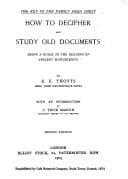
The Key to the Family Deed Chest: How to Decipher and Study Old Documents: Being a Guide to the Reading of Ancient Manuscripts — John Shaqi
The Key to the Family Deed Chest: How to Decipher and Study Old Documents: Being a Guide to the Reading of Ancient ManuscriptsThoyts, Emma Elizabeth
History
The Key to the Family Deed Chest: How to Decipher and Study Old Documents: Being a Guide to the Reading of Ancient Manuscripts
Thoyts, Emma Elizabeth
Diplomatics -- Great Britain; Paleography -- Handbooks, manuals, etc.
Any school-teacher or head of a college, through whose hands a large
correspondence passes, usually contracts a habit of forming conclusions
as to the mental and moral calibre of the writers, their social status
and natural bias of disposition. A round, childish handwriting is said
to show conceit and self-satisfaction. Ignorance and conceit are often
closely linked together. The uneducated generally have a very good
opinion of their own personal qualifications. The most youthful form of
writing is not, therefore, indicative of talent or general capacity,
and seldom shows any originality.
All needless flourishes and ornamentation are the result of egotism
and vanity. But be it remembered that any virtue exaggerated at
once becomes a fault; that whereas a little conceit is necessary to
stimulate ambition, the same in too great excess becomes egotistic
vanity. Genius is apt to overestimate its own depth and originality,
yet without any self-appreciation there is danger of a lack of effort;
despair prevents perseverance, and is a bar to any success.
Excitability, hastiness, and impatience are all seen in the handwriting
at a glance. A quick brain suggests words and sentences so fast, one
upon another, that though the pen races along the page it cannot
write down the ideas quickly enough to satisfy the author. With a
calm, calculating disposition this frantic haste is neither known
nor understood--such persons do not rush to conclusions, but ponder
over every subject. Intuitive perception in the excitable person
becomes judgment in a tranquil mind. Temper depends upon temperament.
The crosses of the letter ‘t’ are the index whereby to judge of it.
If these strokes are regular through a whole page of writing, the
writer may be assumed to have an even-placed temper; if dashed off
at random--quick short strokes, somewhat higher than the letter
itself--quick outbursts of anger may be expected, but of short
duration, unless the stroke is firm and black, in which case great
violence may safely be predicted.
Public-domain text, read in full here on John Shaqi.
Reviews
Reviews
No reviews yet
Be the first to share your thoughts on this work.
Join the Discussion
Join the discussion
Sign in to leave a comment or review.
Sign InorCreate an account