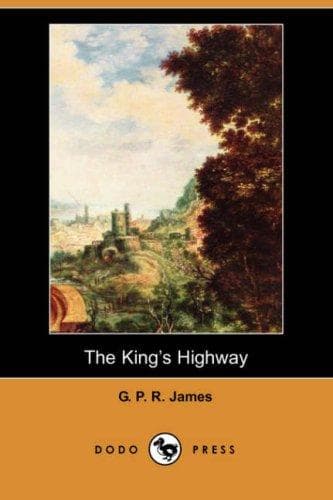
The King's HighwayJames, G. P. R. (George Payne Rainsford)
History
The King's Highway
James, G. P. R. (George Payne Rainsford)
Great Britain -- History -- William and Mary, 1689-1702 -- Fiction
Although accustomed to mingle with the best society; and, in all
ordinary cases, free and unrestrained in his own manners, Wilton Brown
felt some slight awkwardness in introducing himself upon the present
occasion. He accordingly merely gave his name, expressing how much
happiness he felt at the opportunity he had had of serving the Duke; but
referred not at all to his own station or connexion with the Earl of
Sunbury.
"Wilton Brown!" said the Duke, with a meaning smile, and gazing at him
from head to foot, while he mentally contrasted his fine and lofty
appearance, handsome dress, and distinguished manners, with the somewhat
ordinary name which he had given. "Wilton Brown! a NOM DE GUERRE, I
rather suspect, my young friend?"
"No, indeed, my lord," replied Wilton: "were it worth anybody's while to
search, it would be found so written in the books of Christchurch."
"Oh! an Oxonian," cried the Duke, "and doubtless now upon your way to
London. But how is this, my young friend, you are in midst of term
time!"
Wilton smiled at the somewhat authoritative and parental tone assumed by
the old gentleman. "The fact is, my Lord Duke," he said, "that I am
obliged to absent myself, but not without permission. The illness of my
best friend, the Earl of Sunbury, and his approaching departure for
Italy, oblige me to go to London now to see him before he departs."
"Oh, the Earl of Sunbury, the Earl of Sunbury," replied the Duke: "a
most excellent man, and a great statesman, one on whom all parties rely.*
That alters the case, my young friend; and indeed, whatever might be the
cause of your absence from Alma Mater, we have much to thank that cause
for your gallant assistance--especially my poor girl here. Let me shake
hands with you--and now we must think of what is to be done next, for
it is well nigh dark: the carriage is broken by those large stones which
they must have put in the way, doubtless, to stop us; and it is hopeless
to think of getting on farther to-night."
[*Footnote: Let it be remarked that this was not the Earl of Sunderland,
of whom the exact reverse might have been said.]
"Hopeless, indeed, my lord," replied Sir John Fenwick; "but your grace
must have passed on the way hither a little inn, about half a mile
distant, or somewhat more. There I intended to sleep to-night, and most
probably my young friend, too, for his horse seems as tired as mine. If
your grace will follow my advice, you would walk back to the inn, make
your servants take everything out of the carriage, and send some people
down afterwards to drag it to the inn-yard till to-morrow morning."
"It is most unfortunate!" said the Duke, who was fond of retrospects.
"We sent forward the other carriage about three hours before us, in
order that the house in London might be prepared when we came."
Public-domain text, read in full here on John Shaqi.
Reviews
Reviews
No reviews yet
Be the first to share your thoughts on this work.
Join the Discussion
Join the discussion
Sign in to leave a comment or review.
Sign InorCreate an account