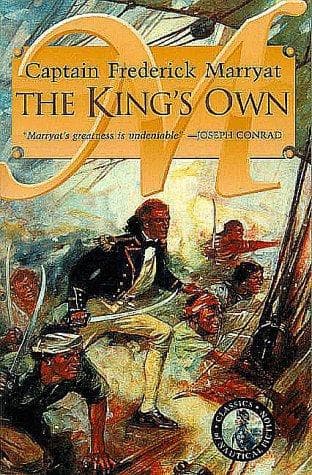
Great Britain -- History, Naval -- 18th century -- Fiction; Nore Mutiny, 1797 -- Fiction
"You will find me an Englishman, body and soul, sir and although I have,
in defence of my profession, been occasionally necessitated to choose
between capture and resistance, I can most conscientiously say, that
every shot I have fired against my own countrymen has smitten me to the
heart;" (and this assertion was true, although we have no time to
analyse McElvina's feelings at present). "I am not bound by honour, nor
have I the least inclination, to conceal any information I may have
obtained, when in the French ports. I went there to serve my purposes,
and they allowed me to do so to serve their own. I never would
(although repeatedly offered bribes) bring them any information relative
to the proceedings of our own country, and I shall most cheerfully
answer your questions; indeed, I have information which I would have
given you before now, had I not felt that it might be supposed I was
actuated more by a view of serving myself than my country. I only wish,
Captain M---, that you may fall in with a French frigate before I leave
your ship, that I may prove to you that I can fight as well for old
England as I have done in defence of property entrusted to my charge."
"Then do me the favour to step down into the cabin," said Captain M---.
Captain M--- and McElvina were shut up in the after-cabin for some time;
and the information received by Captain M--- was so important, that he
determined not to anchor. He put all the French prisoners on board of
the lugger at the entrance of the Sound, and, sending in a boat to take
out the major part of the men who had charge of her, he retained
McElvina on board of the frigate, and made all sail for the French
coast.
CHAPTER FIFTEEN.
That which should accompany old age,
As honour, love, obedience, troops of friends,
I must not look to have.
SHAKESPEARE.
But we must return on shore, that we may not lose sight of the
grandfather of our hero, who had no idea that there was a being in
existence who was so nearly connected with him.
The time had come when that information was to be given; for, about six
weeks previous to the action we have described, in which Adams the
quarter-master was killed, Admiral De Courcy was attacked by a painful
and mortal disease. As long as he was able to move about, his
irritability of temper, increased by suffering, rendered him more
insupportable than ever; but he was soon confined to his room, and the
progress of the disease became so rapid, that the medical attendants
considered it their duty to apprise him that all hopes of recovery must
now be abandoned, and that he must prepare himself for the worst.
Public-domain text, read in full here on John Shaqi.
Reviews
Reviews
No reviews yet
Be the first to share your thoughts on this work.
Elsewhere in the archive
Join the Discussion
Join the discussion
Sign in to leave a comment or review.
Sign InorCreate an account