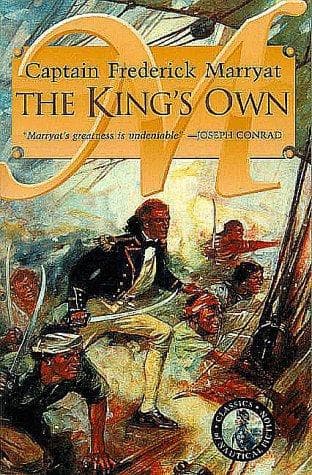
Great Britain -- History, Naval -- 18th century -- Fiction; Nore Mutiny, 1797 -- Fiction
"Curses on the smuggler, he has run for it. At them again, my Britons
never mind," cried the first-lieutenant, leading on the men against the
phalanx of bayonets. But it was not as the first-lieutenant had
supposed; for before the cutlasses of the seamen had time again to
strike fire upon the steel points which opposed their passage, McElvina
reappeared in the fore-rigging of the French vessel, followed by his
smugglers, who attacked the French troops in the rear, with a loud yell,
and an impetuosity that was irresistible. The diversion was announced
by a cheer from Captain M--- and his party abaft, who, rushing upon the
bayonets of the Frenchman, already in confusion from the attack of
McElvina, forced them down on the main-deck, and in a few minutes the
hatches were secured over the remainder of the crew, and the tricoloured
ensign disappeared from the gaff; and announced to the spectators in the
batteries on shore, that "_Britannia ruled the waves_."
CHAPTER SEVENTEEN.
Brave hearts! to Britain's pride
Once so faithful and so true,
On the deck of fame that died
With the gallant, good Riou--
Soft sigh the winds of Heaven o'er their grave!
While the billow mournful rolls,
And the mermaid's song condoles,
Singing glory to the souls
Of the brave!
CAMPBELL.
Hasty congratulations between the survivors of the victorious party were
exchanged as they proceeded to obey the orders which were issued by
Captain M--- who directed their attention to the relief of the wounded,
lying in heaps upon the deck, in many instances nearly smothered with
the dead bodies which had fallen upon them, and which their own
exhausted powers would not permit them to remove. The task of
separation of those who were past all mortal aid from those who might
still derive benefit from surgical assistance, was as tedious as it was
afflicting. No distinction was made between the rival sufferers, but,
as they came to hand, English or French, they were carefully conveyed to
the half-decks of the respective ships, the surgeons of which were in
readiness to receive them, their shirt-sleeves turned up to the elbows,
and hands and arms stained with blood, proving that they had already
been actively employed in the duties of their profession.
On the foremost part of the larboard side of the French frigate's
quarter-deck, where Captain M--- and his crew had boarded, the dead and
dying lay in a heap, the summit of which was level with the tops of the
carronades that they were between; and an occasional low groan from
under the mass, intimated that some were there who were dying more from
the pressure of the other bodies, than from the extent of their own
wounds.
Captain M---, although he had lost much blood, and was still bleeding
profusely, would not leave the deck until he had collected a party to
separate the pile; and many were relieved, who, in a few minutes more,
would have been suffocated.
Public-domain text, read in full here on John Shaqi.
Reviews
Reviews
No reviews yet
Be the first to share your thoughts on this work.
Elsewhere in the archive
Join the Discussion
Join the discussion
Sign in to leave a comment or review.
Sign InorCreate an account