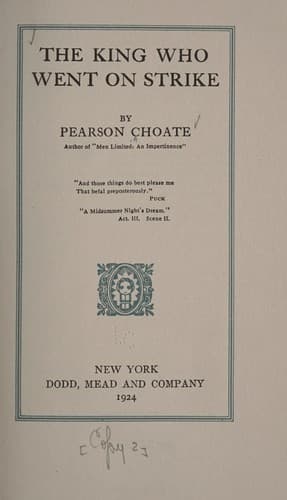
THE KING WHO WENT ON STRIKE
THE KING WHO
WENT ON STRIKE
BY
PEARSON CHOATE
Author of "Men Limited: An Impertinence"
"And those things do best please me
That befal preposterously."
Puck
"A Midsummer Night's Dream."
Act. III. Scene II.
NEW YORK
DODD, MEAD AND COMPANY
1924
Copyright, 1924
BY DODD, MEAD AND COMPANY, INC.
PRINTED IN U.S.A.
VAIL-BALLOU PRESS, INC.
BINGHAMTON AND NEW YORK
"Is it not strange so few Kings abdicate; and none yet heard of has
been known to commit suicide? Fritz the First, of Prussia, alone tried
it, and they cut the rope."
"The French Revolution, A History."
Part I. Book VII. Chapter XI
_Thomas Carlyle_
THE KING WHO WENT ON STRIKE
CHAPTER I
The King leant against the stone balustrade, which runs round the
roof of Buckingham Palace, and looked about him. All around him,
above him, and below him, the night was ablaze with a myriad lights.
Loyal Londoners, in accordance with their custom, were closing their
Coronation celebrations with illuminations, with fireworks, and with
good-humoured horse-play in the crowded streets. In spite of gloomy
predictions to the contrary, the proverbial Coronation weather of the
last day or two had not failed. A radiant June day had given place to
a wonderful June night. Here, on the palace roof, high up above the
tumult and the shouting the night air was cool and fragrant. The King
rested his elbows on the broad top of the carved stone balustrade. He
was very weary. But he was glad to be out in the open air once again.
And he was gladder still, at last, to be alone--
"A tall, fair, goodlooking young man, still in the early twenties,
with an open, almost boyish face": "A young man of athletic build,
clean-shaven, and very like his dead brother, the Prince, but lacking,
perhaps, something of the Prince's personal distinction, and charm":
"Thick, fair, curly hair, blue eyes, and a happy, smiling mouth":
"A typical young English naval officer, with an eager, boyish face,
unclouded, as yet, by any shadow of his high destiny"--it was in
phrases such as these that the descriptive writers in the newspapers
had described, more or less adequately, the new King's outward
appearance. What he was inwardly, what the inner man thought, and felt,
and suffered, was not within their province, or their knowledge. At the
moment, his outward appearance was completed by an easy fitting, black,
smoking jacket, plain evening dress trousers, and a pair of shabby
dancing pumps, into which he had changed immediately after the state
banquet, which had been the final ordeal of his long and exhausting
official day. It was characteristic of the inner man, about whom so
little was known, that he should have been thus impatient to throw
off the gorgeous uniform, and the many unearned decorations, which the
banquet had necessitated. It was characteristic of him, too, that he
should be bareheaded, now, and drawing absently at a pipe, which he had
forgotten to fill--
Public-domain text, read in full here on John Shaqi.
Reviews
Reviews
No reviews yet
Be the first to share your thoughts on this work.
Join the Discussion
Join the discussion
Sign in to leave a comment or review.
Sign InorCreate an account