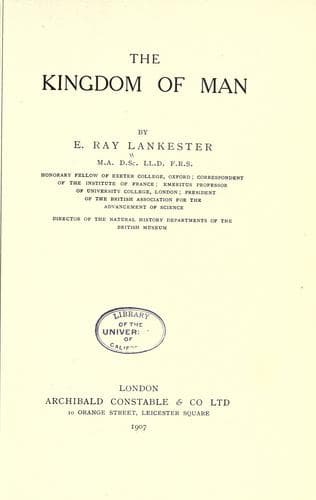
The Kingdom of ManLankester, E. Ray (Edwin Ray), Sir
History
The Kingdom of Man
Lankester, E. Ray (Edwin Ray), Sir
African trypanosomiasis; Human beings; Science -- History
Two general principles which Mr. Darwin fully recognised appear to
me to deserve more consideration and more general application to the
history of species than he had time to give to them, or than his
followers have accorded to them. The first is the great principle
of ‘correlation of variation,’ from which it follows that, whilst
natural selection may be favouring some small and obscure change in
an unseen group of cells--such as digestive, pigmentary or nervous
cells, and that change a change of selective value--there may be,
indeed often is, as we know, a correlated or accompanying change in a
physiologically related part of far greater magnitude and prominence
to the eye of the human onlooker. This accompanying or correlated
character has no selective value, is not an adaptation--is, in
fact, a necessary but useless by-product. A list of a few cases of
this kind was given by Darwin, but it is most desirable that more
should be established. For they enable us to understand how it is
that specific characters, those seen and noted on the surface by
systematists, are not in most cases adaptations of selective value.
They also open a wide vista of incipient and useless developments
which may suddenly, in their turn, be seized upon by ever-watchful
natural selection and raised to a high pitch of growth and function.
The second, somewhat but by no means altogether neglected, principle
is that a good deal of the important variation in both plants and
animals is not the variation of a minute part or confined to one
organ, but has really an inner physiological basis, and may be a
variation of a whole organic system or of a whole tissue expressing
itself at several points and in several shapes. In fact, we should
perhaps more generally conceive of variation as not so much the
accomplishment and presentation of one little mark or difference in
weight, length, or colour, as the expression of a _tendency to vary_
in a given tissue or organ in a particular way. Thus we are prepared
for the rapid extension and dominance of the variation if once it is
favoured by selective breeding. It seems to me that such cases as
the complete disappearance of scales from the integument of some
osseous fishes, or the possible retention of three or four scales
out of some hundreds present in nearly allied forms, favour this
mode of conceiving of variation. So also does the marked tendency
to produce membranous expansions of the integument in the bats, not
only between the digits and from the axilla, but from the ears and
different regions of the face. Of course, the alternative hairy or
smooth condition of the integuments both in plants and animals is a
familiar instance in which a tendency extending over a large area
is recognised as that which constitutes the variation. In smooth or
hairy varieties we do not postulate an individual development of
hairs subjected one by one to selection and survival or repression.
Public-domain text, read in full here on John Shaqi.
Reviews
Reviews
No reviews yet
Be the first to share your thoughts on this work.
Elsewhere in the archive
Join the Discussion
Join the discussion
Sign in to leave a comment or review.
Sign InorCreate an account