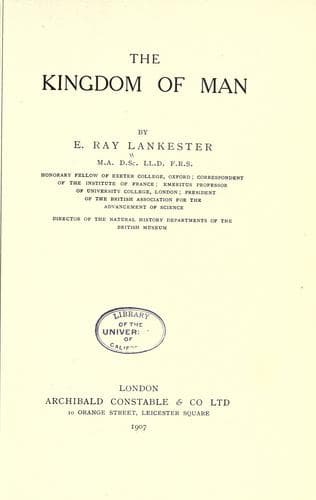
The Kingdom of ManLankester, E. Ray (Edwin Ray), Sir
History
The Kingdom of Man
Lankester, E. Ray (Edwin Ray), Sir
African trypanosomiasis; Human beings; Science -- History
_Disease._--The study of the physiology of unhealthy, injured, or
diseased organisms is called pathology. It necessarily has an immense
area of observation and is of transcending interest to mankind who
do not accept their diseases unresistingly and die as animals do,
so purifying their race, but incessantly combat and fight disease,
producing new and terrible forms of it, by their wilful interference
with the earlier rule of Nature.
Our knowledge of disease has been enormously advanced in the last
quarter of a century, and in an important degree our power of
arresting it, by two great lines of study going on side by side
and originated, not by medical men nor physiologists in the narrow
technical sense, but by naturalists, a botanist, and a zoologist.
Ferdinand Cohn, Professor of Botany in Breslau, by his own researches
and by personal training in his laboratory, gave to Robert Koch the
start on his distinguished career as a bacteriologist. It is to
Metschnikoff the zoologist and embryologist that we owe the doctrine
of phagocytosis and the consequent theory of immunity now so widely
accepted.
We must not forget that in this same period much of the immortal
work of Pasteur on hydrophobia, of Behring and Roux on diphtheria,
and of Ehrlich and many others to whom the eternal gratitude of
mankind is due, has been going on. It is only some fifteen years
since Calmette showed that if cobra poison were introduced into the
blood of a horse in less quantity than would cause death, the horse
would tolerate with little disturbance after ten days a full dose,
and then day after day an increasing dose, until the horse without
any inconvenience received an injection of cobra poison large enough
to kill thirty horses of its size. Some of the horse’s blood being
now withdrawn was found to contain a very active antidote to cobra
poison--what is called an antitoxin. The procedure in the preparation
of the antitoxin is practically the same as that previously adopted
by Behring in the preparation of the antitoxin of diphtheria poison.
Animals treated with injections of these antitoxins are immune to
the poison itself when subsequently injected with it, or, if already
suffering from the poison (as, for instance, by snake-bite), are
readily shown by experiment to be rapidly cured by the injection of
the appropriate antitoxin. This is, as all will admit, an intensely
interesting bit of biology. The explanation of the formation of the
antitoxin in the blood and its mode of antagonising the poison is
not easy. It seems that the antitoxin is undoubtedly formed from the
corresponding toxin or poison, and that the antagonism can be best
understood as a chemical reaction by which the complex molecule of
the poison is upset, or effectively modified.
Public-domain text, read in full here on John Shaqi.
Reviews
Reviews
No reviews yet
Be the first to share your thoughts on this work.
Elsewhere in the archive
Join the Discussion
Join the discussion
Sign in to leave a comment or review.
Sign InorCreate an account