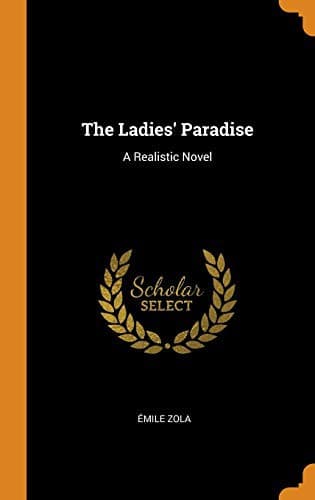
Department stores -- Fiction; Paris (France) -- Fiction; Seduction -- Fiction; Women sales personnel -- Fiction
It remains for me to say a few words concerning the moral of this book.
The story of Denise's struggles, hardships and temptations, her quiet
courage and gentle steadfastness is invested by M. Zola with that
simple pathos which adorns so many of his works. The young girl passes
through the fire and emerges from it unscathed, protected by her own
sense of rectitude and the purity of her love, whilst others, alas,
are devoured. No more beautiful example of feminine resistance to evil
could be imagined. We follow the heroine's fortunes with emotional
interest and take a kindly satisfaction in her reward. Possibly, we
might wish that she had loved a somewhat worthier man than Mouret, in
whom there are many moral blemishes; but the reflection imposes itself,
that under her caressing influence these blemishes will disappear, that
Mouret will throw off all that remains in him of the old Adam and prove
worthy of the love that he himself feels and has inspired. And surely
woman's love can have no holier mission than that of the reformation of
man. What, moreover, would become of humanity if a woman's heart were
to be given only to the immaculate, in accordance with the paradoxical
dictum of some latter day lady-novelists? Does not the woman who brings
an erring man back into the straight path that he may contribute to the
common weal, achieve more good than she who simply plights her troth
to one as blameless as herself? And thus a halo encircles M. Zola's
heroine, Denise, the personification of all that is best and truest in
the female heart.
One word more. The compass of the present introduction does not permit
me to establish a comparison between the relative positions of French
and English salesmen and women in the great drapery establishments.
I fear, however, from all I have heard, that several of M. Zola's
strictures on the treatment meted out to the employees of Octave
Mouret's bazaar, might be applied to English houses. And thus whilst I
recommend this book to women, whom its subject cannot fail to interest
and who will take a warning from the extravagance of Madame Marty and
find a bright example in the unswerving rectitude of Denise, I also
submit it to the attention of those who are seeking in this country to
improve the position of shop employees, for I feel certain that they
will find many a useful hint in its searching and accurate pages.
ERNEST A. VIZETELLY.
_Merton_, May 1895.
[1] I find that Brunet who played the part of M. Calicot wore the
following typical costume: high boots with spurs, white trousers,
a buff waistcoat and a frock coat made of a green and white
"mixture"--_chicorée à la crême_, as the tailors of those days termed
it.
THE LADIES PARADISE.
CHAPTER I.
Public-domain text, read in full here on John Shaqi.
Reviews
Reviews
No reviews yet
Be the first to share your thoughts on this work.
Join the Discussion
Join the discussion
Sign in to leave a comment or review.
Sign InorCreate an account