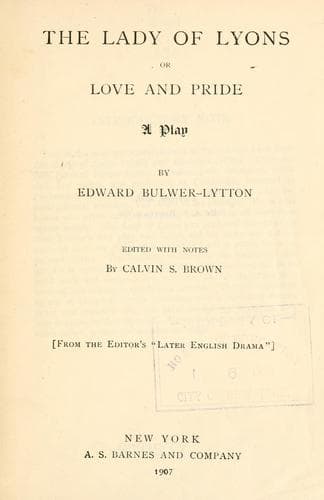
The Lady of Lyons; Or, Love and PrideLytton, Edward Bulwer Lytton, Baron
General
The Lady of Lyons; Or, Love and Pride
Lytton, Edward Bulwer Lytton, Baron
English fiction -- 19th century
Mel. Look you, our bond is over. Proud conquerors that we are, we have
won the victory over a simple girl compromised her honor--embittered
her life--blasted, in their very blossoms, all the flowers of her youth.
This is your triumph,--it is my shame! [Turns to BEAUSEANT.] Enjoy thy
triumph, but not in my sight. I was her betrayer--I am her protector!
Cross but her path--one word of scorn, one look of insult--nay, but one
quiver of that mocking lip, and I will teach thee that bitter word thou
hast graven eternally in this heart--Repentance.
Beau. His highness is most grandiloquent.
Mel. Highness me no more! Beware! Remorse has made me a new being. Away
with you! There is danger in me. Away!
Gla. [aside]. He's an awkward fellow to deal with: come away, Beauseant.
Beau. I know the respect clue to rank. Adieu, my prince. Any commands at
Lyons? Yet hold--I promised you 200 Louis on your wedding-day; here they
are.
Mel. [dashing the purse to the ground]. I gave you revenge, I did not
sell it. Take up your silver, Judas; take it. Ay, it is fit you should
learn to stoop.
Beau. You will beg my pardon for this some clay. [Aside to GLAVIS.] Come
to my chateau--I shall return hither to morrow, to learn how Pauline
likes her new dignity.
Mel. Are you not gone yet?
Beau. Your highness's most obedient, most faithful
Gla. And most humble servants. Ha! ha! [Exeunt BEAUSEANT and GLAVIS.
Mel. Thank heaven I had no weapon, or I should have slain them. Wretch!
what can I say? Where turn? On all sides mockery--the very boors
within--[Laughter from the Inn].--'Sdeath, if even in this short absence
the exposure should have chanced. I will call her. We will go hence. I
have already sent one I can trust to my mother's house. There, at least,
none can insult her agony--gloat upon her shame! There alone must she
learn what a villain she has sworn to love. [As he turns to the door
enter PAULINE from the Inn.
Pauline. Ah! my lord, what a place! I never saw such rude people. They
stare and wink so. I think the very sight of a prince, though he travels
incognito, turns their honest heads. What a pity the carriage should
break down in such a spot! You are not well--the drops stand on your
brow--your hand is feverish.
Mel. Nay, it is but a passing spasm;--the air
Pauline. Is not the soft air of your native south--How pale he
is!--indeed thou art not well. Where are our people? I will call them.
Mel. Hold! I--I am well.
Pauline. Thou art!--Ah! now I know it.
Thou fanciest, my kind lord--I know thou dost--
Thou fanciest these rude walls, these rustic gossips,
Brick'd floors, sour wine, coarse viands, vex Pauline;
And so they might, but thou art by my side,
And I forget all else.
Enter Landlord, the Servants peeping and laughing over his shoulder.
Land. My lord--your highness--Will your most noble excellency choose--
Mel. Begone, sir! [Exit Landlord laughing.
Public-domain text, read in full here on John Shaqi.
Reviews
Reviews
No reviews yet
Be the first to share your thoughts on this work.
Join the Discussion
Join the discussion
Sign in to leave a comment or review.
Sign InorCreate an account