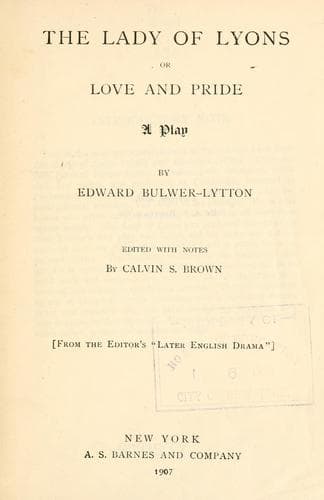
The Lady of Lyons; Or, Love and PrideLytton, Edward Bulwer Lytton, Baron
General
The Lady of Lyons; Or, Love and Pride
Lytton, Edward Bulwer Lytton, Baron
English fiction -- 19th century
Mel. What is past is past. There is a future left to all men, who have
the virtue to repent, and the energy to atone. Thou shalt be proud of
thy son yet. Meanwhile, remember this poor lady has been grievously
injured. For the sake of thy son's conscience, respect, honor, bear with
her. If she weep, console--if she chide, be silent. 'Tis but a little
while more--I shall send an express fast as horse can speed to her
father. Farewell! I shall return shortly.
Widow. It is the only course left to thee--thou wert led astray, but
thou art not hardened. Thy heart is right still, as ever it was when, in
thy most ambitious hopes thou wert never ashamed of thy poor mother.
Mel. Ashamed of thee; No, if I yet endure, yet live, yet hope,--it is
only because I would not die till I have redeemed the noble heritage I
have lost--the heritage I took unstained from thee and my dead father--a
proud conscience and an honest name. I shall win them back yet--heaven
bless you! [Exit.
Widow. My dear Claude! How my heart bleeds for him.
[PAULINE looks down from above, and after a pause descends
Pauline. Not here!--he spares me that pain at least: so far he is
considerate--yet the place seems still more desolate without him.
Oh, that I could hate him--the gardener's son!--and yet how nobly
he--no--no--no I will not be so mean a thing as to forgive him!
Widow. Good morning, madam; I would have waited on you if I had known
you were stirring.
Pauline. It is no matter, ma'am--your son's wife ought to wait on
herself.
Widow. My son's wife--let not that thought vex you, madam--he tells
me that you will have your divorce. And I hope I shall live to see him
smile again. There are maidens in this village, young and fair, madam,
who may yet console him.
Pauline. I dare say--they are very welcome--and when the divorce is
got--he will marry again. I am sure I hope so. [Weeps.
Widow. He could have married the richest girl in the province, if he
had pleased it; but his head was turned, poor child! he could think of
nothing but you. [Weeps.
Pauline. Don't weep, mother.
Widow. Ah, he has behaved very ill, I know, but love is so headstrong in
the young. Don't weep, madam.
Pauline. So, as you were saying--go on.
Widow. Oh, I cannot excuse him, ma'am--he was not in his right senses.
Pauline. But he always--always [sobbing] loved--loved me then?
Widow. He thought of nothing else. See here--he learnt to paint that
he might take your likeness [uncovers the picture]. But that's all over
now--I trust you have cured him of his folly;--but, dear heart, you have
had no breakfast!
Pauline. I can't take anything--don't trouble yourself.
Widow. Nay, madam, be persuaded; a little coffee will refresh you. Our
milk and eggs are excellent. I will get out Claude's coffee-cup--It
is of real Sevres; he saved up all his money to buy it three years ago,
because the name of Pauline was inscribed on it.
Public-domain text, read in full here on John Shaqi.
Reviews
Reviews
No reviews yet
Be the first to share your thoughts on this work.
Join the Discussion
Join the discussion
Sign in to leave a comment or review.
Sign InorCreate an account