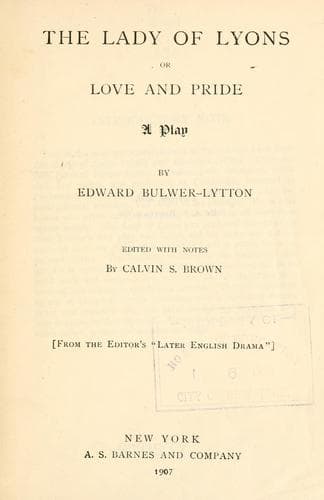
The Lady of Lyons; Or, Love and PrideLytton, Edward Bulwer Lytton, Baron
General
The Lady of Lyons; Or, Love and Pride
Lytton, Edward Bulwer Lytton, Baron
English fiction -- 19th century
Pauline. Is there no hope?
No hope but this?
M. Deschap. None. If, without the sum
Which Beauseant offers for thy hand, this day
Sinks to the west--to-morrow brings our ruin!
And hundreds, mingled in that ruin, curse
The bankrupt merchant! and the insolvent herd
We feasted and made merry cry in scorn,
"How pride has fallen!--Lo, the bankrupt merchant!"
My daughter, thou hast saved us!
Pauline. And am lost!
M. Deschap. Come, let me hope that Beauseant's love--
Pauline. His love!
Talk not of love. Love has no thought of self!
Love buys not with the ruthless usurer's gold
The loathsome prostitution of a hand
Without a heart? Love sacrifices all things
To bless the thing it loves! He knows not love.
Father, his love is hate--his hope revenge!
My tears, my anguish, my remorse for falsehood--
These are the joys that he wrings from our despair!
M. Deschap. If thou deem'st thus, reject him! Shame and ruin
Were better than thy misery;--think no more on't.
My sand is wellnigh run--what boots it when
The glass is broken? We'll annul the contract:
And if to-morrow in the prisoner's cell
These aged limbs are laid, why still, my child,
I'll think thou art spared; and wait the Liberal Hour
That lays the beggar by the side of kings!
Pauline, No--no--forgive me! You, my honor'd father,--
You, who so loved, so cherish'd me, whose lips
Never knew one harsh word! I'm not ungrateful;
I am but human!--hush! Now, call the bridegroom--
You see I am prepared--no tears--all calm;
But, father, talk no more of love
M. Deschap. My child,
Tis but one struggle; he is young, rich, noble;
Thy state will rank first 'mid the dames of Lyons;
And when this heart can shelter thee no more,
Thy youth will not be guardianless.
Pauline. I have set
My foot upon the ploughshare--I will pass
The fiery ordeal. [Aside.] Merciful Heaven, support me;
And on the absent wanderer shed the light
Of happier stars--lost evermore to me!
Enter MADAME DESCHAPPELLES, BEAUSEANT, GLAVIS, and Notary.
Mme. Deschap. Why, Pauline, you are quite in deshabille--you ought to
be more alive to the importance of this joyful occasion. We had once
looked higher, it is true; but you see, after all, Monsieur Beauseant's
father was a Marquis, and that's a great comfort. Pedigree and
jointure!--you have them both in Monsieur Beauseant. A young lady
decorously brought up should only have two considerations in her choice
of a husband; first, is his birth honorable? secondly, will his death
be advantageous? All other trifling details should be left to parental
anxiety.
Beau. [approaching and waving aside Madame]. Ah, Pauline! let me hope
that you are reconciled to an event which confers such rapture upon me.
Pauline. I am reconciled to my doom.
Beau. Doom is a harsh word, sweet lady.
Public-domain text, read in full here on John Shaqi.
Reviews
Reviews
No reviews yet
Be the first to share your thoughts on this work.
Join the Discussion
Join the discussion
Sign in to leave a comment or review.
Sign InorCreate an account