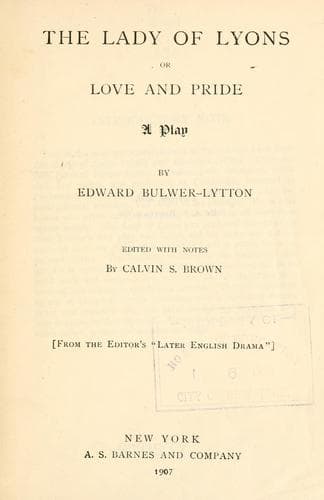
The Lady of Lyons; Or, Love and PrideLytton, Edward Bulwer Lytton, Baron
General
The Lady of Lyons; Or, Love and Pride
Lytton, Edward Bulwer Lytton, Baron
English fiction -- 19th century
See, this is her image--painted from memory. Oh, how the canvas wrongs
her!--[Takes up the brush and throws it aside.] I shall never be a
painter! I can paint no likeness but one, and that is above all art.
I would turn soldier--France needs soldiers! But to leave the air
that Pauline breathes! What is the hour?--so late? I will tell thee
a secret, mother. Thou knowest that for the last six weeks I have sent
every day the rarest flowers to Pauline?--she wears them. I have seen
them on her breast. Ah, and then the whole universe seemed filled
with odors! I have now grown more bold--I have poured my worship into
poetry--I have sent the verses to Pauline--I have signed them with my
own name. My messenger ought to--be back by this time. I bade him wait
for the answer.
Widow. And what answer do you expect, Claude?
Mel. That which the Queen of Navarre sent to the poor troubadour:--"Let
me see the Oracle that can tell nations I am beautiful!" She will admit
me. I shall hear her speak--I shall meet her eyes--I shall read upon
her cheek the sweet thoughts that translate themselves into blushes.
Then--then, oh, then--she may forget that I am the peasant's son!.
Widow. Nay, if she will but hear thee talk, Claude?
Mel. I foresee it all. She will tell me that desert is the true rank.
She will give me a badge--a flower--a glove! Oh rapture! I shall join
the armies of the republic--I shall rise--I shall win a name that
beauty will not blush to hear. I shall return with the right to say to
her--"See, how love does not level the proud, but raise the--humble!"
Oh, how my heart swells within me!--Oh, what glorious prophets of the
future are youth and hope!
[Knock at the door.]
Widow. Come in.
Enter GASPAR.
Mel. Welcome, Gaspar, welcome. Where is the letter? Why do you turn
away, man? where is the letter? [GASPAR gives him one.] This! This is
mine, the one I intrusted to thee. Didst thou not leave it?
Gaspar. Yes, I left it.
Mel. My own verses returned to me. Nothing else!
Gaspar. Thou wilt be proud to hear how thy messenger was honored.
For thy sake, Melnotte, I have borne that which no Frenchman can bear
without disgrace.
Mel. Disgrace, Gaspar! Disgrace?
Gaspar. I gave thy letter to the porter, who passed it from lackey to
lackey till it reached the lady it was meant for.
Mel. It reached her, then; you are sure of that! It reached her,--well,
well!
Gaspar. It reached her, and was returned to me with blows. Dost hear,
Melnotte? with blows! Death! are we slaves still, that we are to be thus
dealt with, we peasants?
Mel. With blows? No, Gaspar, no; not blows!
Gaspar. I could show thee the marks if it were not so deep a shame to
bear them. The lackey who tossed thy letter into the mire swore that
his lady and her mother never were so insulted. What could thy letter
contain, Claude?
Mel. [looking over the letter]. Not a line that a serf might not have
written to an empress. No, not one.
Public-domain text, read in full here on John Shaqi.
Reviews
Reviews
No reviews yet
Be the first to share your thoughts on this work.
Join the Discussion
Join the discussion
Sign in to leave a comment or review.
Sign InorCreate an account