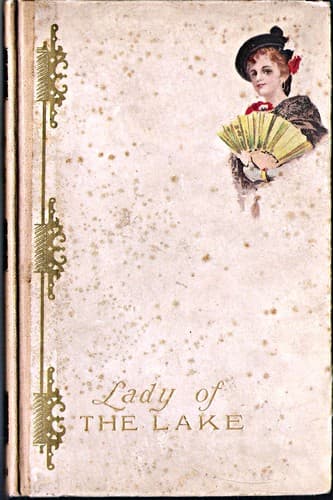
Arthurian romances; Lady of the Lake (Legendary character) -- Romances
7. A minstrel gray. "That Highland chieftains, to a late period,
retained in their service the bard, as a family officer, admits of very
easy proof. The author of the Letters from the North of Scotland, an
officer of engineers, quartered at Inverness about 1720, who certainly
cannot be deemed a favorable witness, gives the following account of
the office, and of a bard, whom he heard exercise his talent of
recitation:--'The bard is killed in the genealogy of all the Highland
families, sometimes preceptor to the young laird, celebrates in Irish
verse the original of the tribe, the famous warlike actions of the
successive heads, and sings his own lyricks as an opiate to the chief,
when indisposed for sleep; but poets are not equally esteemed and
honored in all countries. I happened to be a witness of the dishonour
done to the muse, at the house of one of the chiefs, where two of these
bards were set at a good distance, at the lower end of a long table,
with a parcel of Highlanders of no extraordinary appearance, over a cup
of ale. Poor inspiration! They were not asked to drink a glass of wine
at our table, though the whole company consisted only of the great man,
one of his near relations, and myself. After some little time, the chief
ordered one of them to sing me a Highland song. The bard readily obeyed,
and with a hoarse voice, and in a tune of few various notes, began, as
I was told, one of his own lyricks; and when he had proceeded to the
fourth of fifth stanza, I perceived, by the names of several persons,
glens, and mountains, which I had known or heard of before, that it
was an account of some clan battle. But in his going on, the chief (who
piques himself upon his school-learning) at some particular passage,
bid him cease, and cryed out, "There's nothing like that in Virgil or
Homer." I bowed, and told him I believed so. This you may believe was
very edifying and delightful'" (Scott).
15. Than men, etc. "It is evident that the old bard, with his
second-sight, has a glimmering notion who the stranger is. He speaks
below {311} of 'courtly spy,' and James's speech had betrayed a
knowledge of the Douglas" (Taylor).
20. Battled. The reading of the 1st ed. and that of 1821; "battle" in
most others. Cf. i. 626 above.
22. Where beauty, etc. The MS. has "At tourneys where the brave resort."
The reference is to the tournaments, "Where," as Milton says (L'Allegro,
119),
"throngs of knights and barons bold.
In weeds of peace, high triumphs hold,
With store of ladies, whose bright eyes
Rain influence, and judge the prize
Of wit or arms, while both contend
To win her grace whom all commend."
Cf. 87 below.
26. Love's. The reading of the 1st ed. and that of 1821; most eds. have
"love."
29. Plaided. The plaid was properly the dress of a Highlander, though it
was worn also in the Lowlands.
51. The Harper on the islet beach. "This picture is touched with the
hand of the true poet" (Jeffrey).
Public-domain text, read in full here on John Shaqi.
Reviews
Reviews
No reviews yet
Be the first to share your thoughts on this work.
Elsewhere in the archive
Join the Discussion
Join the discussion
Sign in to leave a comment or review.
Sign InorCreate an account