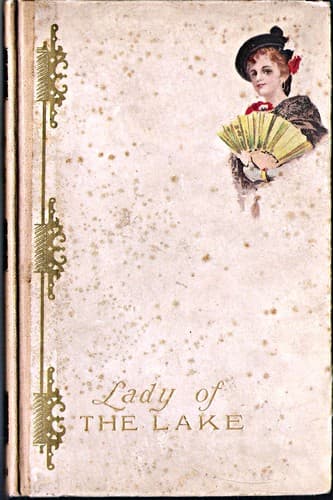
Arthurian romances; Lady of the Lake (Legendary character) -- Romances
98. Broke. Quartered. Cf. the quotation from Jonson below. Scott says
here: "Everything belonging to the chase was matter of solemnity among
our ancestors; but nothing was more so than the mode of cutting up,
or, as it was technically called, breaking, the slaughtered stag. The
forester had his allotted portion; the hounds had a certain allowance;
and, to make the division as general as possible, the very birds had
their share also. 'There is a little gristle,' says Tubervile, 'which
is upon the spoone of the brisket, which we call the raven's bone; and I
have seen in some places a raven so wont and accustomed to it, that
she would never fail to croak and cry for it all the time you were in
breaking up of the deer, and would not depart till she had it.' In the
very ancient metrical romance of Sir Tristrem, that peerless knight,
who is said to have been the very deviser of all rules of chase, did not
omit the ceremony:
'The rauen he yaue his yiftes
Sat on the fourched tre.' [9]
"The raven might also challenge his rights by the Book of St. Albans;
for thus says Dame Juliana Berners:
'slitteth anon
The bely to the side, from the corbyn bone;
That is corbyns fee, at the death he will be.'
Jonson, in The Sad Shepherd, gives a more poetical account of the same
ceremony:
'Marian. He that undoes him,
Doth cleave the brisket bone, upon the spoon
Of which a little gristle grows--you call it
Robin Hood. The raven's bone.
Marian. Now o'er head sat a raven
On a sere bough, a grown, great bird, and hoarse,
Who, all the while the deer was breaking up,
So croaked and cried for 't, as all the huntsmen,
Especially old Scathlock, thought it ominous.'"
115. Rouse. Rise, stand erect. Cf. Macbeth, v. 5. 12:
"The time has been, my senses would have cool'd
To hear a night-shriek, and my fell of hair
Would at a dismal treatise rouse and stir
As life were in 't."
119. Mine. Many eds. have "my."
128. Fateful. The reading of the 1st ed. and that of 1821; "fatal" in
some recent eds.
132. Which spills, etc. The MS. has "Which foremost spills a foeman's
life."
"Though this be in the text described as a response of the Taghairm, or
Oracle of the Hide, it was of itself an augury frequently attended to.
The fate of the battle was often anticipated, in the imagination of the
combatants, by observing which party first shed blood. It is said that
the Highlanders under Montrose were so deeply imbued with this notion,
that on the morning of the battle of Tippermoor, they murdered a
defenceless herdsman, whom they found in the fields, merely to secure an
advantage of so much consequence to their party" (Scott).
140. A spy. That is, Fitz-James. For has sought, the 1st ed. has "hath
sought."
144. Red Murdoch, etc. The MS. has "The clansman vainly deemed his
guide," etc.
Public-domain text, read in full here on John Shaqi.
Reviews
Reviews
No reviews yet
Be the first to share your thoughts on this work.
Elsewhere in the archive
Join the Discussion
Join the discussion
Sign in to leave a comment or review.
Sign InorCreate an account