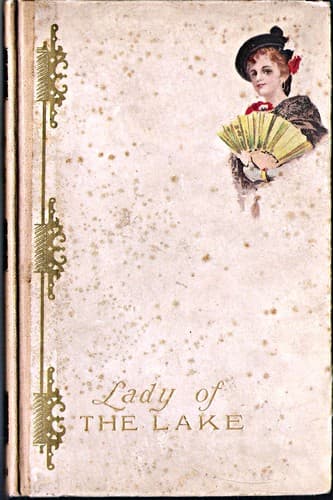
Arthurian romances; Lady of the Lake (Legendary character) -- Romances
'They are believed to inhabit certain round grassy eminences, where they
celebrate their nocturnal festivities by the light of the moon. About a
mile beyond the source of the Forth, above Loch Con, there is a placed
called Coirshi'an, or the Cove of the Men of Peace, which is still
supposed to be a favorite place of their residence. In the neighborhood
are to be seen many round conical eminences, particularly one near the
head of the lake, by the skirts of which many are still afraid to pass
after sunset. It is believed that if, on Hallow-eve, any person,
alone, goes round one of these hills nine times, towards the left hand
(sinistrorsum) a door shall open, by which he will be admitted into
their subterraneous abodes. Many, it is said, of mortal race have been
entertained in their secret recesses. There they have been received
into the most splendid apartments, and regaled with the most sumptuous
banquets and delicious wines. Their females surpass the daughters of men
in beauty. The seemingly happy inhabitants pass their time in festivity,
and in dancing to notes of the softest music. But unhappy is the mortal
who joins in their joys or ventures to partake of their dainties. By
this indulgence he forfeits for ever the society of men, and is bound
down irrevocably to the condition of Shi'ich, or Man of Peace.'"
301. Why sounds, etc. "It has been already observed that fairies, if not
positively malevolent, are capricious, and easily offended. They are,
like other proprietors of forests, peculiarly jealous of their rights of
vert and venison.... This jealousy was also an attribute of the northern
Duergar, or dwarfs; to many of whose distinctions the fairies seem so
have succeeded, if, indeed, they are not the same class of beings. In
the huge metrical record of German chivalry entitled the Helden-Buch,
Sir Hildebrand, and the other heroes of whom it treats, are engaged in
one of their most desperate adventures, from a rash violation of the
rose-garden of an Elfin or Dwarf King.
"There are yet traces of a belief in this worst and most malicious order
of fairies among the Border wilds. Dr. Leyden has introduced such a
dwarf into his ballad entitled The Cout of Keeldar, and has not forgot
his characteristic detestation of the chase.
'The third blast that young Keeldar blew,
Still stood the limber fern,
And a wee man, of swarthy hue,
Upstarted by a cairn.
'His russet weeds were brown as heath
That clothes the upland fell,
And the hair of his head was frizzy red
As the purple heather-bell.
'An urchin, clad in prickles red,
Clung cow'ring to his arm;
The hounds they howl'd, and backward fled,
As struck by fairy charm.
'"Why rises high the staghound's cry,
Where staghound ne'er should be?
Why wakes that horn the silent morn,
Without the leave of me?"--
Public-domain text, read in full here on John Shaqi.
Reviews
Reviews
No reviews yet
Be the first to share your thoughts on this work.
Elsewhere in the archive
Join the Discussion
Join the discussion
Sign in to leave a comment or review.
Sign InorCreate an account