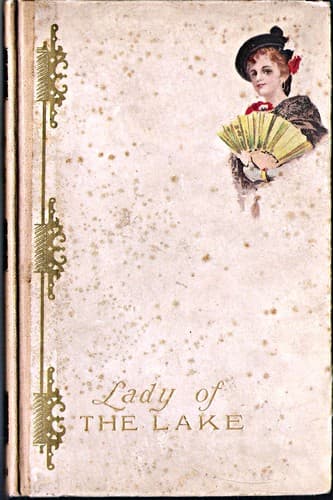
Arthurian romances; Lady of the Lake (Legendary character) -- Romances
"like as a Beare,
That creeping close among the hives to reare
An hony-combe," etc.
Wb. does not give this sense, which we believe is found only in Spenser.
165. Shall with strong hand, etc. Scott has the following note here:
"The ancient Highlanders verified in their practice the lines of Gray
(Fragment on the Alliance of Education and Government):
'An iron race the mountain cliffs maintain,
Foes to the gentler genius of the plain;
For where unwearied sinews must be found,
With side-long plough to quell the flinty ground,
To turn the torrent's swift descending flood,
To tame the savage rushing from the wood,
What wonder if, to patient valor train'd,
They guard with spirit what by strength they gain'd;
And while their rocky ramparts round they see
The rough abode of want and liberty
(As lawless force from confidence will grow),
Insult the plenty of the vales below?'
"So far, indeed, was a Creagh, or foray, from being held disgraceful,
that a young chief was always expected to show his talents for command
so soon as he assumed it, by leading his clan on a successful enterprise
of this nature, either against a neighboring sept, for which constant
feuds usually furnished an apology, or against the Sassencach, Saxons,
or Lowlanders, for which no apology was necessary. The Gael, great
traditional historians, never forgot that the Lowlands had, at some
remote period, been the property of their Celtic forefathers, which
furnished an ample vindication of all the ravages that they could make
on the unfortunate districts which lay within their reach. Sir James
Grant of Grant is in possession of a letter of apology from Cameron of
Lochiel, whose men had committed some depredation upon a farm called
Moines, occupied by one of the Grants. Lochiel assures Grant that,
however the mistake had happened, his instructions were precise, that
the party should foray the province of Moray (a Lowland district),
where, as he coolly observes, 'all men take their prey.'"
177. Good faith. In good faith, bona fide; as often in old writers.
192. Bower. See on i. 217 above.
195. This rebel Chieftain, etc. The MS. reads:
"This dark Sir Roderick | and his band;"
This savage Chieftain |
and below:
"From copse to copse the signal flew.
Instant, through copse and crags, arose;"
and in 205 "shoots" for sends.
208. And every tuft, etc. The MS. reads:
"And each lone tuft of broom gives life
To plaided warrior armed for strife.
That whistle manned the lonely glen
With full five hundred armed men;"
and below (214):
"All silent, too, they stood, and still,
Watching their leader's beck and will,
While forward step and weapon show
They long to rush upon the foe,
Like the loose crag whose tottering mass
Hung threatening o'er the hollow pass."
219. Verge. See on iv. 83 above.
Public-domain text, read in full here on John Shaqi.
Reviews
Reviews
No reviews yet
Be the first to share your thoughts on this work.
Elsewhere in the archive
Join the Discussion
Join the discussion
Sign in to leave a comment or review.
Sign InorCreate an account