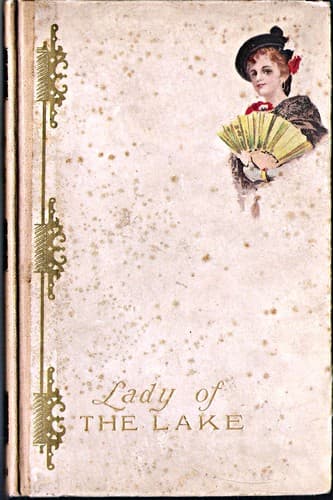
Arthurian romances; Lady of the Lake (Legendary character) -- Romances
230. Manned himself. Cf. Addison's "manned his soul," quoted by Wb.
238. The stern joy, etc. Cf. iv. 155 above.
239. Foeman. The reading of the 1st ed. and that of 1821; "foeman" in
many recent eds.
246. Their mother Earth, etc. Alluding to the old myths of the
earth-born Giants and of Cadmus.
252. Glinted. Flashed; a Scottish word. Jamieson defines glint "to
glance, gleam, or pass suddenly like a flash of lightning."
253. Glaive. See on iv. 274 above. The jack was "a horseman's defensive
upper garment, quilted and covered with strong leather" (Nares). It
was sometimes also strengthened with iron rings, plates, or bosses. Cf.
Lyly, Euphues: "jackes quilted, and covered over with leather, fustian,
or canvas, over thick plates of yron that are sowed to the same." Scott,
in the Eve of St. John, speaks of "his plate-jack." For spear the 1st
ed. has "lance."
267. One valiant hand. The MS. has "one brave man's hand."
268. Lay. Were staked.
270. I only meant, etc. Scott says: "This incident, like some other
passages in the poem, illustrative of the character of the ancient Gael,
is not imaginary, but borrowed from fact. The Highlanders, with the
inconsistency of most nations in the same state, were alternately
capable of great exertions of generosity and of cruel revenge and
perfidy. The following story I can only quote from tradition, but with
such an assurance from those by whom it was communicated as permits me
little doubt of its authenticity. Early in the last century, John Gunn,
a noted Cateran, or Highland robber, infested Inverness-shire, and
levied black-mail up to the walls of the provincial capital. A garrison
was then maintained in the castle of that town, and their pay (country
banks being unknown) was usually transmitted in specie under the guard
of a small escort. It chanced that the officer who commanded this
little party was unexpectedly obliged to halt, about thirty miles
from Inverness, at a miserable inn. About nightfall, a stranger in the
Highland dress, and of very prepossessing appearance, entered the same
house. Separate accommodations being impossible, the Englishman offered
the newly-arrived guest a part of his supper, which was accepted with
reluctance. By the conversation he found his new acquaintance knew well
all the passes of the country, which induced him eagerly to request his
company on the ensuing morning. He neither disguised his business and
charge, nor his apprehensions of that celebrated freebooter, John Gunn.
The Highlander hesitated a moment, and then frankly consented to be
his guide. Forth they set in the morning; and in travelling through
a solitary and dreary glen, the discourse again turned on John Gunn.
'Would you like to see him?' said the guide; and without waiting an
answer to this alarming question, he whistled, and the English officer,
with his small party, were surrounded by a body of Highlanders, whose
numbers put resistance out of question, and who were all well armed.
Public-domain text, read in full here on John Shaqi.
Reviews
Reviews
No reviews yet
Be the first to share your thoughts on this work.
Elsewhere in the archive
Join the Discussion
Join the discussion
Sign in to leave a comment or review.
Sign InorCreate an account