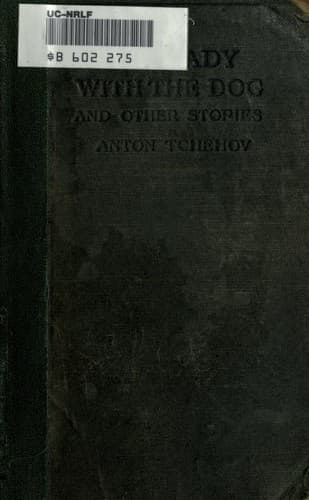
The Lady with the Dog and Other StoriesChekhov, Anton Pavlovich
General
The Lady with the Dog and Other Stories
Chekhov, Anton Pavlovich
Chekhov, Anton Pavlovich, 1860-1904 -- Translations into English; Russia -- Social life and customs -- Fiction
The parting took place between seven and eight. He put one arm round
her, and kissed her on the lips and on the forehead.
"Be a good girl, and don't be depressed while I am away," he said in a
warm, affectionate tone which touched even me. "God keep you!"
She looked greedily into his face, to stamp his dear features on her
memory, then she put her arms gracefully round his neck and laid her
head on his breast.
"Forgive me our misunderstandings," she said in French. "Husband and
wife cannot help quarrelling if they love each other, and I love you
madly. Don't forget me.... Wire to me often and fully."
Orlov kissed her once more, and, without saying a word, went out in
confusion. When he heard the click of the lock as the door closed, he
stood still in the middle of the staircase in hesitation and glanced
upwards. It seemed to me that if a sound had reached him at that moment
from above, he would have turned back. But all was quiet. He
straightened his coat and went downstairs irresolutely.
The sledges had been waiting a long while at the door. Orlov got into
one, I got into the other with two portmanteaus. It was a hard frost and
there were fires smoking at the cross-roads. The cold wind nipped my
face and hands, and took my breath away as we drove rapidly along; and,
closing my eyes, I thought what a splendid woman she was. How she loved
him! Even useless rubbish is collected in the courtyards nowadays and
used for some purpose, even broken glass is considered a useful
commodity, but something so precious, so rare, as the love of a refined,
young, intelligent, and good woman is utterly thrown away and wasted.
One of the early sociologists regarded every evil passion as a force
which might by judicious management be turned to good, while among us
even a fine, noble passion springs up and dies away in impotence, turned
to no account, misunderstood or vulgarised. Why is it?
The sledges stopped unexpectedly. I opened my eyes and I saw that we had
come to a standstill in Sergievsky Street, near a big house where
Pekarsky lived. Orlov got out of the sledge and vanished into the entry.
Five minutes later Pekarsky's footman came out, bareheaded, and, angry
with the frost, shouted to me:
"Are you deaf? Pay the cabmen and go upstairs. You are wanted!"
At a complete loss, I went to the first storey. I had been to Pekarsky's
flat before--that is, I had stood in the hall and looked into the
drawing-room, and, after the damp, gloomy street, it always struck me by
the brilliance of its picture-frames, its bronzes and expensive
furniture. To-day in the midst of this splendour I saw Gruzin,
Kukushkin, and, after a minute, Orlov.
"Look here, Stepan," he said, coming up to me. "I shall be staying here
till Friday or Saturday. If any letters or telegrams come, you must
bring them here every day. At home, of course you will say that I have
gone, and send my greetings. Now you can go."
Public-domain text, read in full here on John Shaqi.
Reviews
Reviews
No reviews yet
Be the first to share your thoughts on this work.
Elsewhere in the archive
Join the Discussion
Join the discussion
Sign in to leave a comment or review.
Sign InorCreate an account