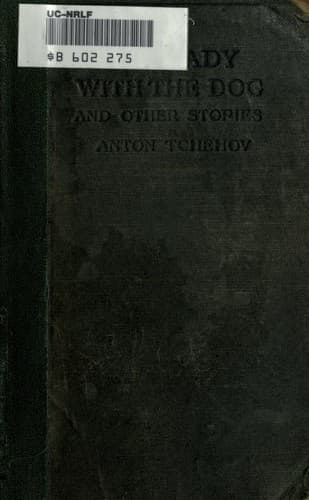
The Lady with the Dog and Other StoriesChekhov, Anton Pavlovich
General
The Lady with the Dog and Other Stories
Chekhov, Anton Pavlovich
Chekhov, Anton Pavlovich, 1860-1904 -- Translations into English; Russia -- Social life and customs -- Fiction
"What does this mean?" she cried, knocking at his door. "What ... what
does this mean?" she repeated in a shrill voice breaking with
indignation. "Ah, so this is what you do! Then let me tell you I hate
you, I despise you! Everything is over between us now."
I heard hysterical weeping mingled with laughter. Something small in the
drawing-room fell off the table and was broken. Orlov went out into the
hall by another door, and, looking round him nervously, he hurriedly put
on his great-coat and went out.
Half an hour passed, an hour, and she was still weeping. I remembered
that she had no father or mother, no relations, and here she was living
between a man who hated her and Polya, who robbed her--and how desolate
her life seemed to me! I do not know why, but I went into the
drawing-room to her. Weak and helpless, looking with her lovely hair
like an embodiment of tenderness and grace, she was in anguish, as
though she were ill; she was lying on a couch, hiding her face, and
quivering all over.
"Madam, shouldn't I fetch a doctor?" I asked gently.
"No, there's no need ... it's nothing," she said, and she looked at me
with her tear-stained eyes. "I have a little headache.... Thank you."
I went out, and in the evening she was writing letter after letter, and
sent me out first to Pekarsky, then to Gruzin, then to Kukushkin, and
finally anywhere I chose, if only I could find Orlov and give him the
letter. Every time I came back with the letter she scolded me, entreated
me, thrust money into my hand--as though she were in a fever. And all
the night she did not sleep, but sat in the drawing-room, talking to
herself.
Orlov returned to dinner next day, and they were reconciled.
The first Thursday afterwards Orlov complained to his friends of the
intolerable life he led; he smoked a great deal, and said with
irritation:
"It is no life at all; it's the rack. Tears, wailing, intellectual
conversations, begging for forgiveness, again tears and wailing; and the
long and the short of it is that I have no flat of my own now. I am
wretched, and I make her wretched. Surely I haven't to live another
month or two like this? How can I? But yet I may have to."
"Why don't you speak, then?" said Pekarsky.
"I've tried, but I can't. One can boldly tell the truth, whatever it may
be, to an independent, rational man; but in this case one has to do with
a creature who has no will, no strength of character, and no logic. I
cannot endure tears; they disarm me. When she cries, I am ready to swear
eternal love and cry myself."
Pekarsky did not understand; he scratched his broad forehead in
perplexity and said:
"You really had better take another flat for her. It's so simple!"
Public-domain text, read in full here on John Shaqi.
Reviews
Reviews
No reviews yet
Be the first to share your thoughts on this work.
Elsewhere in the archive
Join the Discussion
Join the discussion
Sign in to leave a comment or review.
Sign InorCreate an account