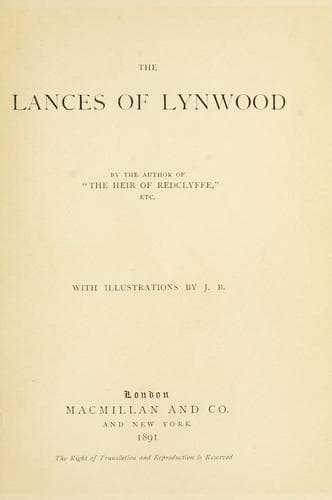
The Lances of LynwoodYonge, Charlotte M. (Charlotte Mary)
History
The Lances of Lynwood
Yonge, Charlotte M. (Charlotte Mary)
Great Britain -- History -- Edward III, 1327-1377 -- Fiction
"They will murder him," exclaimed Eustace; and breaking from his new
friends, he made his way to the gate, and hurried into the town, just
as Fulk had fallen to the ground, struck by a heavy stone hurled by the
hand of no other than John Ingram. He rushed forward amid the hail of
stones, and, as he lifted Clarenham's head, called out, "How is this!
Brave men of Bordeaux, would you become murderers! Is this like
honourable men, to triumph over the fallen!"
They held back in amazement for a second; then, as Eustace knelt by him
and tried to recall his consciousness, murmurs arose, "Why interferes
he with our affairs? He is English," and they all held together.
"Another of the purse-proud English, who pay no debts, and ruin the
poor Bordelais." "His blood we will have, if we cannot have his money.
Away, Master Knight, be not so busy about the traitor, if you would not
partake his fate."
Eustace looked up as the stones were uplifted, and more than one Free
Companion had drawn his sword. "Hold," he exclaimed in a clear
full-toned voice that filled every ear. "Hold! I am Eustace Lynwood,
the Castellane of Chateau Norbelle!"
There was an instant silence. Every one pressed forward to see him,
whose recent adventures had made him an object of much interest and
curiosity, and the attention of the crowd was entirely diverted from
the former unhappy subject of their pursuit. Whispers passed of "Noble
Knight! flower of chivalry! how generous and Christian-like he bends
over his enemy! Nay, if he revenge not himself, what right have we?
And see, his arm is still in a scarf from the treachery of those
villains! Well, I would yet give yon ruffian his desert."
By this time Eustace having observed Ingram among the crowd, summoned
him to his side, and at the same time courteously craving the aid of
one of the by-standers (who, of course, though collectively lions, were
individually lambs), succeeded in conveying Clarenham, whose senses had
so far returned that he was able to rise with their assistance, to the
door of a monastery chapel, the porch of which opened upon the street.
"Holy Fathers," said Eustace, "I crave the protection of the Church for
an unhappy, and, I trust, a penitent man, praying you will tend him
well to aid and relief alike of body and soul, until you hear from me
again."
With these words he quitted the chapel before his late enemy had
sufficiently recovered his faculties to recognize his preserver.
Leonard Ashton, for whom Eustace inquired, had, it appeared, saved
himself by making full confession, and had been sent home, in deep
disgrace, though spared public dishonour.
Public-domain text, read in full here on John Shaqi.
Reviews
Reviews
No reviews yet
Be the first to share your thoughts on this work.
Elsewhere in the archive
Join the Discussion
Join the discussion
Sign in to leave a comment or review.
Sign InorCreate an account