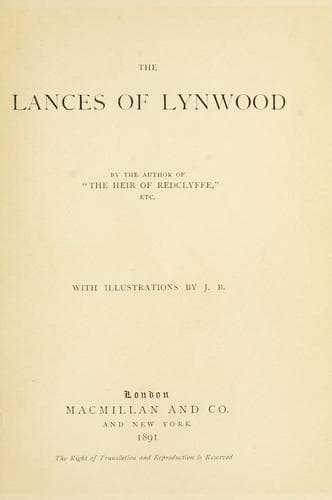
The Lances of LynwoodYonge, Charlotte M. (Charlotte Mary)
History
The Lances of Lynwood
Yonge, Charlotte M. (Charlotte Mary)
Great Britain -- History -- Edward III, 1327-1377 -- Fiction
It was some few days after these events that the presence of Lady Agnes
de Clarenham was requested in the parlour of her nunnery, which was
some miles distant from Bordeaux, by a person who, as the porteress
informed her, was the bearer of a message from the Princess of Wales.
She descended accordingly, but her surprise was great on beholding,
instead of one of the female attendants of her mistress as she had
expected, the slender figure of the young Knight with whom she had last
parted at the hostelry.
Her first feeling was not one of kindness towards him. Agnes had
indeed grieved and felt indignant when she saw him oppressed and in
danger from her brother's treachery, but, in these days of favour, she
could not regard with complacency the cause of her brother's ruin, and
of the disgrace of her house. She started, and would have retreated,
but that he prevented, by saying, in a tone which had in it more of
sorrow than of any other feeling, "Lady Agnes, I pray you to hear
me--for you have much to forgive."
"Forgive! Nay, Sir Eustace, it is you who have so much to forgive my
unhappy house! Oh, can you," she added, as the countenance and manner
recalling long past days made her forget her displeasure, "can you tell
me where the wretched one has shrouded his head from the shame which
even I cannot but confess he has merited?"
"I heard of the Bar--of your brother this very morn," said Eustace,
"from one of the good brethren of the Convent where he has taken
shelter, the Convent of the Augustine friars of St. Mary; they spoke of
him as amended in health, and, though sorely dejected, returning, they
hoped, to a better spirit.'
"Thanks, Sir Eustace, even so do I hope and pray it may be--since
repentance is the only good which can yet be his. But tell me, Sir
Eustace--for vague rumours only reach us in this lonely cell--was it
true that the populace pursued the fallen one with clamours, and might
even have slain him, but for his rescue by a gallant Knight, who braved
their utmost fury?"
"It was even so, Lady," said Eustace, with some embarrassment.
"Oh! who was that noblest of Knights, that I may name him in my most
fervent prayers? who has that strongest claim on the gratitude of the
broken-hearted sister?"
"Nay, Lady, it was but common duty, the mere mercy of a Christian man,
who could not see a fellow-creature die such a death, without
attempting to save him."
"Oh, Sir Eustace! it is not like your former self to deny the greatness
of a noble deed! I will not be robbed of my gratitude! Tell me the
name of that most noble of men!"
He half smiled, then looking down, and colouring deeply: "Do you
remember, Lady Agnes, the Knight whom you bound by a promise, that in
case of the triumph of his cause--"
Public-domain text, read in full here on John Shaqi.
Reviews
Reviews
No reviews yet
Be the first to share your thoughts on this work.
Elsewhere in the archive