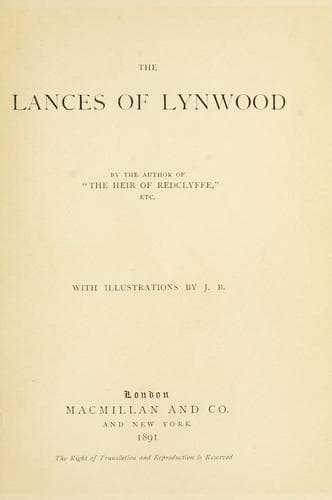
The Lances of LynwoodYonge, Charlotte M. (Charlotte Mary)
History
The Lances of Lynwood
Yonge, Charlotte M. (Charlotte Mary)
Great Britain -- History -- Edward III, 1327-1377 -- Fiction
"Eustace, Eustace! Oh, I should have known that nothing was too great
and high for you, that you would not disparage the nobleness of any
other than yourself. Oh, how shall I ever render you my thanks! After
such cruel treachery as that from which you have, and, I fear me, are
still suffering! Alas! alas! that I should be forced to use such harsh
words of my own brother!"
"I trust you may still be comforted, Lady," said Eustace. "From what
the good Fathers tell me, there is hope that Fulk may yet be an altered
man, and when the pilgrimage to the Holy Land, which he has vowed, is
concluded, may return in a holy temper."
"Return; but whither should he return?" said Agnes, in a broken,
despondent tone,--"landless, homeless, desolate, outcast, what shelter
is open to him? For if the porteress's tale spoke truth, his lands and
manors are forfeited to the King."
"They are so, in truth; but there is one way, Agnes, in which they may
still be restored to their true owner."
"How so? What mean you, Sir Eustace?"
"Agnes, I would not have broken upon your sorrow by speaking thus
abruptly, but that the Prince's, or rather the King's desire was
urgent, that the matter should be determined without loss of time. To
you, in all justice, does he will that the castles and manors of
Clarenham should descend, but on one condition."
Agnes raised her eyes, and, while she slowly shook her head, looked
anxiously at him as he paused in considerable embarrassment.
"On condition that you, Lady Agnes, should permit the King and Prince
to dispose of your fair hand in marriage."
Agnes gave a slight cry, and leant against the grate of the parlour.
"Oh, that may never be, and--but how advantageth that poor Fulk?"
"Because, Lady Agnes--because it is to me that they would grant that
hand which I have so long loved passionately and hopelessly. Agnes, it
was not willingly, but at the command of the Prince, that I came hither
with a suit which must seem to you most strangely timed, from one who
has been the most unwilling cause of so much misery to you, whom, from
earliest years, he has ever loved more than his own life. I know, too,
that you cannot endure to rise on the ruin of your brother, nor could I
bear to feel that I was living on the lands of a kinsman and neighbour
whose overthrow I had wrought. But see you not, that jointly we can do
what we never could do separately, that, the condition fulfilled, we
could kneel before King Edward, and entreat for the pardon and
restoration of Fulk, which, to such prayers, he would surely grant?"
Public-domain text, read in full here on John Shaqi.
Reviews
Reviews
No reviews yet
Be the first to share your thoughts on this work.
Elsewhere in the archive
Join the Discussion
Join the discussion
Sign in to leave a comment or review.
Sign InorCreate an account