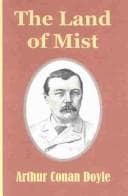
Challenger, Professor (Fictitious character) -- Fiction; Spiritualism -- Fiction
Malone sat at the side table of the smoking-room of the Literary Club.
He had Enid’s impressions of the séance before him--very subtle and
observant they were--and he was endeavouring to merge them in his own
experience. A group of men were smoking and chatting round the fire.
This did not disturb the journalist, who found, as many do, that his
brain and his pen worked best sometimes when they were stimulated by the
knowledge that he was part of a busy world. Presently, however, somebody
who observed his presence brought the talk round to psychic subjects,
and then it was more difficult for him to remain aloof. He leaned back
in his chair and listened.
Polter, the famous novelist, was there, a brilliant man with a subtle
mind, which he used too often to avoid obvious truth and to defend some
impossible position for the sake of the empty dialectic exercise. He was
holding forth now to an admiring, but not entirely a subservient
audience.
“Science,” said he, “is gradually sweeping the world clear of all these
old cobwebs of superstition. The world was like some old, dusty attic,
and the sun of science is bursting in, flooding it with light, while the
dust settles gradually to the floor.”
“By science,” said someone maliciously, “you mean, of course, men like
Sir William Crookes, Sir Oliver Lodge, Sir William Barrett, Lombroso,
Richet, and so forth.”
Polter was not accustomed to be countered, and usually became rude.
“No, sir, I mean nothing so preposterous,” he answered, with a glare.
“No name, however eminent, can claim to stand for science so long as he
is a member of an insignificant minority of scientific men.”
“He is, then, a crank,” said Pollifex, the artist, who usually played
jackal to Polter.
The objector, one Millworthy, a free-lance of journalism, was not to be
so easily silenced.
“Then Galileo was a crank in his day,” said he. “And Harvey was a crank
when he was laughed at over the circulation of the blood.”
“It’s the circulation of the _Daily Gazette_ which is at stake,” said
Marrible, the humorist of the club. “If they get off their stunt I don’t
suppose they care a tinker’s curse what is truth or what is not.”
“Why such things should be examined at all, except in a police court, I
can’t imagine,” said Polter. “It is a dispersal of energy, a
misdirection of human thought into channels which lead nowhere. We have
plenty of obvious, material things to examine. Let us get on with our
jobs.”
Atkinson, the surgeon, was one of the circle, and had sat silently
listening. Now he spoke.
“I think the learned bodies should find more time for the consideration
of psychic matters.”
“Less,” said Polter.
Public-domain text, read in full here on John Shaqi.
Reviews
Reviews
No reviews yet
Be the first to share your thoughts on this work.
Join the Discussion
Join the discussion
Sign in to leave a comment or review.
Sign InorCreate an account