No steamers can land at the island. Both passengers and freight have to
be lightered ashore. The inner bay was filled with ice. We anchored
five miles out. I went ashore with a friend in his gasoline launch
which had been sent out for him. We left the _St. Croix_ at two-thirty,
and we had to get out several times and pull the boat along the ice
until we could launch her again in open water. At seven o'clock we
reached the beach. I stepped ashore and took a look at what was to be
my abiding-place for the next five years. Home was never like this! I
was informed that the largest building in sight was the Steamboat
Hotel. I took my way thither and was the sole occupant of this
now-historic hostlery for more than a week.
CHAPTER II
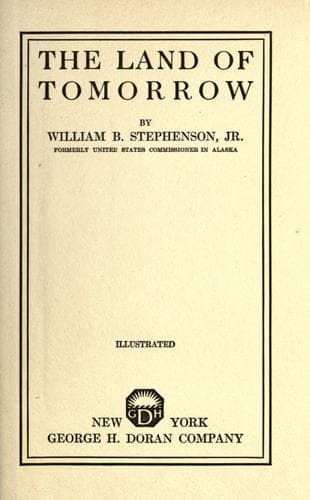
THE LAND OF TOMORROW
The writer lays no claim to being an historian, but a word in regard to
Alaska's early history and how the country came to be a part of our
national possessions may not be amiss.
When the Russians first came to the island of Unalaska they learned
from the natives there of a vast country lying to eastward, the name of
which was _Alayeksa_. Their own island, one of the Aleutian group, they
called _Nagun-Alayeksa_, which means "the land next to Alayeksa." As is
usually the case, especially in primitive languages, the word was
gradually modified and in time it assumed three different forms. The
Russians called the country itself _Alashka_. The peninsula became
_Aliaska_, the island _Unalaska_. In English the word changed once more
to the present name, _Alaska_, which means "The Great Country." It is a
fitting name. All honor to those two good Americans, Seward and Sumner,
who in the teeth of the most withering scorn, ridicule, and even
opprobrium, saved for our country her most glorious and valuable
possession,--the land discovered and partly explored by Vitus Bering in
1741.
The old saying that "Westward the star of empire takes its way" is not
applicable to Alaska. She enjoys a reputation wholly unique in the
history of nations. She is the only country acquired by any European
power in America because of expansion _eastward_. The territory which
lies between the Atlantic Ocean and the Mississippi River was our
inheritance from the mother country. The two Floridas, Texas, New
Mexico, and California we acquired, either directly or indirectly, from
Spain. From France we purchased Louisiana. But about the middle of the
sixteenth century there began in Russia a movement eastward similar to
that which followed (westward) the American Revolution in our own
country.
Public-domain text, read in full here on John Shaqi.
Reviews
Reviews
No reviews yet
Be the first to share your thoughts on this work.
Join the Discussion
Join the discussion
Sign in to leave a comment or review.
Sign InorCreate an account