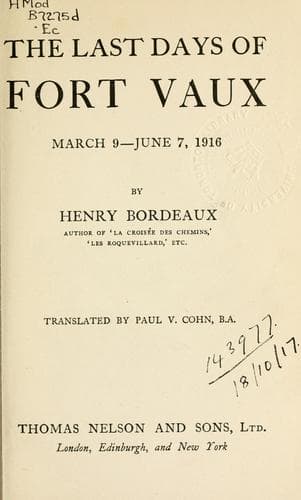
The Last Days of Fort Vaux, March 9-June 7, 1916Bordeaux, Henry
History
The Last Days of Fort Vaux, March 9-June 7, 1916
Bordeaux, Henry
Verdun, Battle of, Verdun, France, 1916; World War, 1914-1918 -- Personal narratives
The fort, now shrunken, became enveloped in the mists of winter. It
heard less and less of the guns. Its diminished garrison grew bored
in the almost deserted corridors. The news which came from the rear
contained mysterious hints of a great Allied offensive which was slowly
preparing and would develop when the time was ripe, perhaps not before
the summer of 1916: England would methodically complete her gigantic
new military machine, and Russia would need time to heal the wounds
inflicted on her during the 1915 campaign. It is flattering, when one
lives on the border of the Woevre, to have such distant and important
friends, even if they need a certain amount of time for settling their
affairs.
In January and February 1916 the fort felt certain qualms:
“I don’t like being left so quiet as this. We know nothing here, but we
have intuitions. Things are moving on the other side. Surely something
is brewing.”
Things were moving indeed in the forest of Spincourt and in that
of Mangiennes. Our aviators must have some inkling of it, for they
make more and more frequent flights. But the soil is ill-fitted for
observation, with its countless dips and its undergrowth. Even where
there are no leaves, the brushwood defends itself against aerial
photographers.
Information comes that the railway of Spincourt, Muzeray,
Billy-sous-Mangiennes, is working in unaccustomed fashion. It seems
that the big calibre guns have been detrained.
We are assured that new German corps have been brought into the
district, among them the 3rd, which is returning from Serbia.
Finally, the belfries of Rouvres, Mangiennes, Grémilly, Foameix--how
had they been spared till then?--were overthrown by the Germans: no
doubt they might have served as guiding marks for our artillery!
Whence come these vague rumours and these definite reports? There
is no chance of finding out for certain. The soldiers who come
back from Verdun bring them back and retail them. Silence is not a
French virtue. There is uneasiness in the air. Yet the weather is
so appalling--squalls of wind and snowstorms--that the attack seems
unlikely, or at any rate postponed.
“To-morrow,” thinks the fort, which has faith in the strength of its
walls. “Or the day after.”
On February 20 the weather takes a turn for the better. On the 21st, at
seven o’clock in the morning, the first shell falls on Verdun, near the
cathedral. The greatest battle of the greatest war is beginning.
BOOK II
THE BATTLE
I
THE FLIGHT OF THE RAVENS
THE observers on aeroplanes or balloons who saw the volcano burst into
flame declared that they could not mark on their maps all the batteries
that were in action. The woods of Consenvoye, Moirey, Hingry, and
Grémilly, the forests of Spincourt and Mangiennes, the hillsides of
Romagne and Mormont, breathed fire like myriads of monstrous dragons.
Public-domain text, read in full here on John Shaqi.
Reviews
Reviews
No reviews yet
Be the first to share your thoughts on this work.
Join the Discussion
Join the discussion
Sign in to leave a comment or review.
Sign InorCreate an account