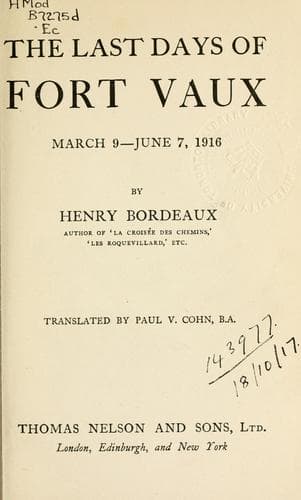
The Last Days of Fort Vaux, March 9-June 7, 1916Bordeaux, Henry
History
The Last Days of Fort Vaux, March 9-June 7, 1916
Bordeaux, Henry
Verdun, Battle of, Verdun, France, 1916; World War, 1914-1918 -- Personal narratives
Being an impassioned lover of his own beautiful country of Savoy, he
is one of the many modern novelists who have identified themselves
with a particular region, and invested their books with local colour.
At the same time he is a brilliant chronicler of Parisian life. Above
all, M. Bordeaux belongs to the school of writers who have raised the
tone of French fiction, and freed it from the old reproach of cynicism,
frivolity, and immorality. A keen analyst of the modern spirit, he
represents all the sterling qualities that have placed France in the
front rank among civilized nations. Says one of his countrymen, “Henry
Bordeaux has the soul of a poet, a thinker, and a soldier, a soul
ardently in love with beautiful rhythms and with noble efforts, a
soul firm as a rock and luxuriant as the valleys of its birthplace.”
His writings are of peculiar interest at the present moment, when
France, in her glorious struggle against a brutal invader, is showing
the world how sorely her enemies, and even some of her friends, had
misjudged her, when they thought she was a prey to decadence. He
typifies the reaction from the morbid introspection and ferocious
egotism that have marred the work of so many poets and dramatists. A
passage in _Les Roquevillard_ strikes the keynote of his philosophy.
“There is no fine individual destiny. There is no greatness but in
service. We serve our family, our country, science, an ideal, God.
Shame to those who only serve themselves.” This is the teaching of his
novel, _La Peur de vivre_, which illustrates the healing influence
of self-sacrifice carried to a well-nigh superhuman extreme; of that
powerful study of family solidarity, _The Roquevillards_, and of his
tragedy of forgiveness, _La Neige sur les pas_. Another touching story
of Dauphiné, _La Croisée des Chemins_, resumes the theme of _Les
Roquevillard_, and _La Robe de laine_ portrays the mind of a simple
girl whose personality cannot be crushed by the juggernaut of modern
society or fall a victim to worldly success. These are but a few of the
novels and short stories in which M. Bordeaux has painted lofty ideals
in the colours of life, and not only touched us with their beauty, but
also convinced us of their truth.
In August 1914, as a captain in the reserves, M. Bordeaux at once left
for the front in command of a company of territorial infantry, and in
due course took part in the desperate fighting of which this book is a
record.
In the Battle of Verdun, which broke the back of the German invasion
and completed the work that the victories of the Marne and the Yser had
begun, two out of the thirty forts which defended the fortress were
lost: Fort Douaumont on the evening of February 25, 1916, and Fort Vaux
on the morning of June 7.
Public-domain text, read in full here on John Shaqi.
Reviews
Reviews
No reviews yet
Be the first to share your thoughts on this work.
Join the Discussion
Join the discussion
Sign in to leave a comment or review.
Sign InorCreate an account