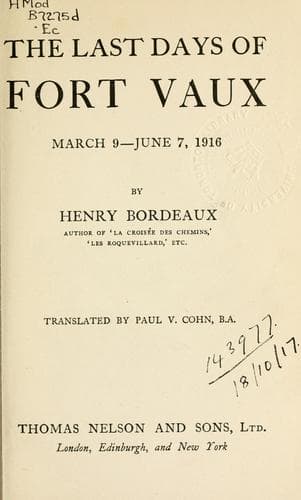
The Last Days of Fort Vaux, March 9-June 7, 1916Bordeaux, Henry
History
The Last Days of Fort Vaux, March 9-June 7, 1916
Bordeaux, Henry
Verdun, Battle of, Verdun, France, 1916; World War, 1914-1918 -- Personal narratives
I recall those confabulations on the mountains before undertaking a
climb which offered some difficulty or other, or, in Lovitel’s hut in
Dauphiné, those little councils of war on the eve of a chamois hunt:
one would take this path, another that couloir; another speaks of a
dangerous place, and thinks it best to use a rope. After this, at
daybreak, we shake hands and set off, each by his own route, to meet at
the appointed place.
We go up the side of the ravine again and come to a wood that grows
sparser and sparser. Yes, it is indeed the beginning of a difficult
climb. The air is keen, and so bright is the moon that the stars are
scarcely visible. As we climb higher the vegetation becomes more
scanty; the trees are now stunted--a few hardy larches, with twisted
roots, persist in growing; then comes the zone of sickly shrubs;
finally there is nothing left but the bare ground. The same order is
found here; around me there are a large number of trees, but they are
in fragments, the branches broken, the trunks battered, the roots
protruding from the riven soil, and soon they are nothing but miserable
broomsticks. The summit, where lies the region of ice and desolation,
cannot be far off.
Yet the mountain has the unrivalled advantage of silence. We accustom
ourselves so quickly to the murmur of the torrents that roll at
the bottom., and even that murmur is like the hidden refrain that
accompanies a day-dream. Here we are obsessed by that continual,
sharp, menacing, formidable whistle which precedes the bursting of a
shell. And sometimes we have to stop, to lie down or to plunge into a
crater--there are only too many places to choose from--and wait until
the storm has passed over. When the curtain fire breaks off for a
while, we resume our journey. The ground is riddled like a sieve; at
the cross-roads the corpses, men or horses, lie in piles. The light of
the moon covers them with a mysterious winding sheet.
We stop at the stone quarry which forms the brigade headquarters.
There, too, a chief is still awake, and finishing a plan of operations.
Tall, very youthful-looking, with a ringing voice and a hearty manner,
he too appears one of those born trainers of men who know how to unite
method with dash. What a clearness they all show in their reports and
anticipations! What importance they attach to the sparing of lives!
What frankness in their tone, what an art of going straight to the
point! Here there is no longer any toadying or vanity or desire to
please. A sort of moral elevation, the result of their leadership, has
come to mark their character. When one is acquainted with the matter in
hand, a simple telephone conversation is a model of clear language and
logical reasoning.
Thus, from one post to another, the dialogue is prolonged into the
night. One seems to visit a series of catacombs where a rite is
performed by the dim light of the sanctuary lamp. One goes away with a
sense of religious reverence.
Public-domain text, read in full here on John Shaqi.
Reviews
Reviews
No reviews yet
Be the first to share your thoughts on this work.
Join the Discussion
Join the discussion
Sign in to leave a comment or review.
Sign InorCreate an account