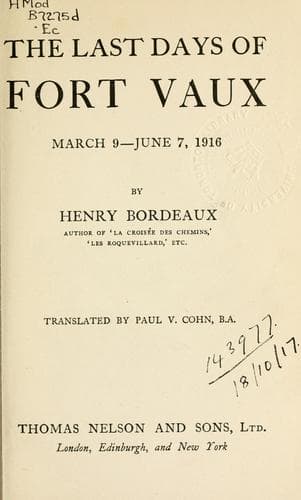
The Last Days of Fort Vaux, March 9-June 7, 1916Bordeaux, Henry
History
The Last Days of Fort Vaux, March 9-June 7, 1916
Bordeaux, Henry
Verdun, Battle of, Verdun, France, 1916; World War, 1914-1918 -- Personal narratives
At noon the bombardment increases in force. At six o’clock in the
evening it breaks off abruptly. The village and fort are both attacked
at once. This is the sudden frontal attack, daring, almost foolhardy,
which the enemy pursued with success at the outset of the Verdun
battle, relying on his artillery superiority and on surprise or loss of
nerve in the ranks of his opponents. He is not master of La Caillette
Wood or of Damloup, he has no grip either on our right or on our left.
He confines operations to a stubborn obstacle whose possession would
ensure him a salient in our lines, and he dashes against it as hard as
he can, like a battering-ram against a door.
On the fort the assault is delivered in successive waves, not in a
cordon but in small columns, now directly in front of the parapets,
now slantwise on our left, between the cemetery and the fort, where he
finds a battalion of the 408th. In the barbed wire there are gaps that
our men have been unable to repair, dating from previous bombardments.
No doubt the enemy, from photographs by his airmen, imagines them to be
more important than they really are. He is faced by our machine-guns
and rifles along the whole line. From six to eight in the evening he
returns to the charge with a tenacity and vigour which it is only fair
to acknowledge. He wants to break through at all costs. All his efforts
are in vain. Our gallant lads’ rifles grow so hot that they have to be
relieved. The Territorials ask, as a favour, to be allowed to undertake
this shift. They acquit themselves even better than their young
comrades. They remember their lying in wait for game and their fine
marksmanship, on Sundays, on the borders of the forests of Anjou. To be
a good shot, one needs a steady nerve and one must never be in a hurry.
Inside the fort the soldiers of the Regular battalion have finished
cleaning and greasing their rifles. They feel comparatively
comfortable. One of them, however, makes a suggestion:
“The old ’uns are still down there. Are they to be left there, they in
front and we behind?”
No one looks reluctant. The officers have no need to insist. But the
“old ’uns” will not hear of giving up the position, which they consider
a good one, since the field of fire is perfect but for that confounded
drop in the ground where the Boches vanish as if through a trap-door.
The 75-gun plays its part in the affray. Its curtain fire, at the foot
of Hardaumont, works wonders. From the parapets one sees legs and arms
flying in the air. The reinforcements will not come. They are urgently
needed.
Night has fallen. A second lieutenant attached to the Brigade Staff
and dispatched to this part of the battlefield comes down from the
fort at a run. In spite of the cold, he is perspiring when he reaches
headquarters.
Public-domain text, read in full here on John Shaqi.
Reviews
Reviews
No reviews yet
Be the first to share your thoughts on this work.
Join the Discussion
Join the discussion
Sign in to leave a comment or review.
Sign InorCreate an account