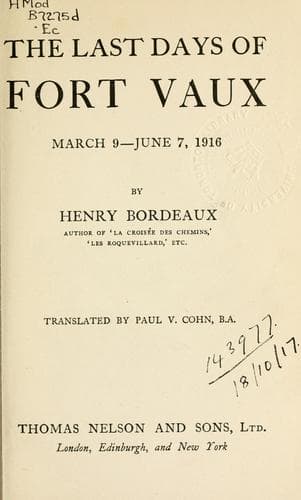
The Last Days of Fort Vaux, March 9-June 7, 1916Bordeaux, Henry
History
The Last Days of Fort Vaux, March 9-June 7, 1916
Bordeaux, Henry
Verdun, Battle of, Verdun, France, 1916; World War, 1914-1918 -- Personal narratives
Fort Vaux followed them from its observing stations and saw them
break through by the southern breach. It aided them with its guns in
the direction of Hardaumont and La Caillette. And its walls, which
resounded under the enemy’s bombardment, seemed to tremble with joy,
even as the hills of Israel leapt, at the deliverance of its old
comrade.
From the fort of Vaux to the pool the defences staked out on the slopes
of the hill are connected by three redoubts or entrenchments more or
less knocked to pieces, R¹, R², and R³ in the abbreviated style of
the reports. Captain Delvert, who from May 17 to 24 has occupied R¹
with the 8th Company of the 101st Regiment, and who will occupy it
again from May 31 to June 5, during the critical period, is one of
those officers whom the war has revealed to themselves by abruptly
withdrawing them from the civilian careers in which they had earned
distinction. A student and a thinker, with a fellowship in history,
he is the contemporary and was the close friend of Emile Clermont,
the tender, subtle, and pathetic novelist of _Laure_ and _Amour
Promis_, who before he was killed in a trench was able to draw lessons
favourable to his inner development from the scenes of bloodshed which
he held in instinctive horror.
His generation was at that meeting-place of all the roads of the new
age which has been marked by a certain indecision in all, or nearly
all, of us in our turn: the war, making him a leader of men, will have
prepared him for leadership in the intellectual world. He wears the
Legion of Honour and the War Cross. Of middle height, with a sunburnt
complexion, his eyes full of glittering fire behind his pince-nez,
his voice low and his gestures eloquent, he has acquired the habit
of looking at himself from outside recommended by Stendhal and his
followers. He analyzes himself while he acts. He sees himself in action
without being inconvenienced by the presence of this clear-sighted
eye-witness. Accordingly he has a precise notion of all that is
happening, and realizes the full significance of each event. The
background of the canvas does not escape him; he can easily reproduce
the stage-setting of the episodes, which he paints like an artist, with
rapid, sweeping strokes and warm colours. Men of this type will later
on make admirable chroniclers. At the most tragic moments he notices
the statuesque pose of a bomb-thrower, or is capable of feeling the
warm caress of a sunbeam. More than once I shall have recourse to the
notes which he has allowed me to consult: the concise yet passionate
style of his personal comments must be left to the imagination.
Public-domain text, read in full here on John Shaqi.
Reviews
Reviews
No reviews yet
Be the first to share your thoughts on this work.
Elsewhere in the archive
Join the Discussion
Join the discussion
Sign in to leave a comment or review.
Sign InorCreate an account