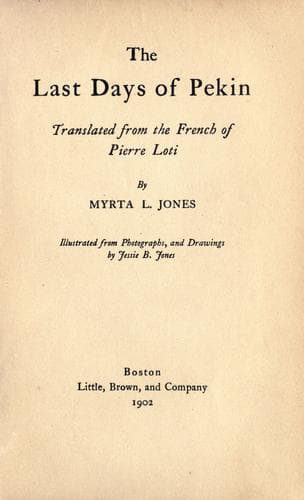
Beijing (China) -- Description and travel; Beijing (China) -- History -- Siege, 1900
It snows. The sky is lowering and overcast, with no hope of clearing,
as though there were no longer any sun. A furious north wind is
blowing, and the black dust whirls and eddies, commingling with the
snowflakes.
This morning, my first interview with our minister took place at the
Spanish legation. His temperature has fallen, but he is still very
weak, and must remain in bed for some days, so I am obliged to postpone
until to-morrow or the day after the communications I have to make to
him.
I take my last meal with the members of the French legation in the
chancellor's house, where, in default of sumptuous quarters, they have
offered me the most kindly hospitality. At half-past one the two little
Chinese chariots arrive, lent me for the emigration of myself, my
people, and my light luggage to the Yellow City.
The Chinese chariots are very small, very massive, very heavy, and
entirely without springs; mine has something of the elegance of a
hearse; the outside is covered with a slaty-gray silk, with a wide
border of black velvet.
We are to journey toward the northwest, in the opposite direction
from the Chinese City where we were yesterday, and from the Temple
of Heaven. We have five or six kilometres to go almost at a walk, on
account of the pitiable condition of the streets and bridges, where
most of the paving stones are missing.
These Chinese chariots cannot be closed; they are like a simple sentry
box mounted on wheels,--so to-day we are lashed by the wind, cut by the
snow, blinded by the dust.
First come the ruins of the legation district, full of soldiers. Then
more lonely, almost deserted and entirely Chinese ruins--one gray,
dusty devastation, seen vaguely through clouds of black and clouds
of white. At the gates and on the bridges are European or Japanese
sentinels, for the whole city is under military rule. From time to time
we meet soldiers and ambulances carrying the flag of the Red-Cross
Society.
At last the first enclosure of the Yellow or Imperial City is announced
by the interpreter of the French legation, who has kindly offered to
be my guide, and to share my chariot with its funeral trappings. I try
to look, but the wind burns my eyes.
We are passing with frightful jolts through great blood-colored
ramparts, not by way of a gate, but through a breach made with a mine
by Indian cavalrymen.
Pekin, on the farther side of this wall, is somewhat less injured.
In some of the streets the houses have kept their outside covering
of gilded woodwork and their rows of chimæras along the edges of the
roofs; all this is crumbling and decayed, it is true, licked by the
flames or riddled by grape-shot. An evil-looking rabble, dressed in
sheepskins or blue cotton rags, still swarms in some of the houses.
Public-domain text, read in full here on John Shaqi.
Reviews
Reviews
No reviews yet
Be the first to share your thoughts on this work.
Join the Discussion
Join the discussion
Sign in to leave a comment or review.
Sign InorCreate an account