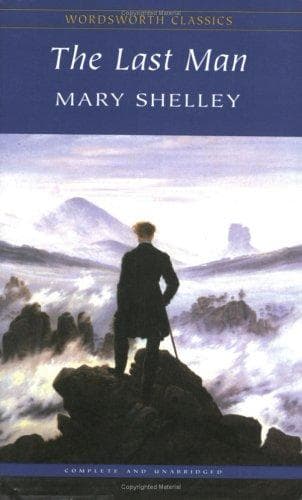
End of the world -- Fiction; Epidemics -- Fiction; Science fiction; Twenty-first century -- Fiction
He did not explain himself, nor did I make any remark on his reply. Our
silence endured for some miles, till the country with open fields, or
shady woods and parks, presented pleasant objects to our view. After
some observations on the scenery and seats, Raymond said: “Philosophers
have called man a microcosm of nature, and find a reflection in the
internal mind for all this machinery visibly at work around us. This
theory has often been a source of amusement to me; and many an idle
hour have I spent, exercising my ingenuity in finding resemblances.
Does not Lord Bacon say that, ‘the falling from a discord to a concord,
which maketh great sweetness in music, hath an agreement with the
affections, which are re-integrated to the better after some dislikes?’
What a sea is the tide of passion, whose fountains are in our own
nature! Our virtues are the quick-sands, which shew themselves at calm
and low water; but let the waves arise and the winds buffet them, and
the poor devil whose hope was in their durability, finds them sink from
under him. The fashions of the world, its exigencies, educations and
pursuits, are winds to drive our wills, like clouds all one way; but
let a thunderstorm arise in the shape of love, hate, or ambition, and
the rack goes backward, stemming the opposing air in triumph.”
“Yet,” replied I, “nature always presents to our eyes the appearance of
a patient: while there is an active principle in man which is capable
of ruling fortune, and at least of tacking against the gale, till it in
some mode conquers it.”
“There is more of what is specious than true in your distinction,” said
my companion. “Did we form ourselves, choosing our dispositions, and
our powers? I find myself, for one, as a stringed instrument with
chords and stops—but I have no power to turn the pegs, or pitch my
thoughts to a higher or lower key.”
“Other men,” I observed, “may be better musicians.”
“I talk not of others, but myself,” replied Raymond, “and I am as fair
an example to go by as another. I cannot set my heart to a particular
tune, or run voluntary changes on my will. We are born; we choose
neither our parents, nor our station; we are educated by others, or by
the world’s circumstance, and this cultivation, mingling with our
innate disposition, is the soil in which our desires, passions, and
motives grow.”
“There is much truth in what you say,” said I, “and yet no man ever
acts upon this theory. Who, when he makes a choice, says, Thus I
choose, because I am necessitated? Does he not on the contrary feel a
freedom of will within him, which, though you may call it fallacious,
still actuates him as he decides?”
“Exactly so,” replied Raymond, “another link of the breakless chain.
Were I now to commit an act which would annihilate my hopes, and pluck
the regal garment from my mortal limbs, to clothe them in ordinary
weeds, would this, think you, be an act of free-will on my part?”
Public-domain text, read in full here on John Shaqi.
Reviews
Reviews
No reviews yet
Be the first to share your thoughts on this work.
Join the Discussion
Join the discussion
Sign in to leave a comment or review.
Sign InorCreate an account