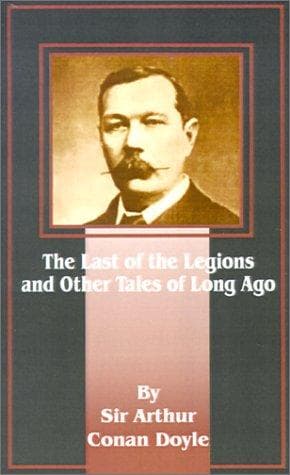
The Last of the Legions and Other Tales of Long AgoDoyle, Arthur Conan
General
The Last of the Legions and Other Tales of Long Ago
Doyle, Arthur Conan
Adventure stories, English; Historical fiction, English; Short stories, English
Too late did the Romans understand the man with whom they had to deal.
Their boarders who had flooded the Punic decks felt the planking sink
and sway beneath them. They rushed to gain their own vessels; but they,
too, were being drawn downwards, held in the dying grip of the great red
galley. Over they went and ever over. Now the deck of Magro's ship is
flush with the water, and the Romans', drawn towards it by the iron
bonds which hold them, are tilted downwards, one bulwark upon the waves,
one reared high in the air. Madly they strain to cast off the death-grip
of the galley. She is under the surface now, and ever swifter, with the
greater weight, the Roman ships heel after her. There is a rending
crash. The wooden side is torn out of one, and mutilated, dismembered,
she rights herself, and lies a helpless thing upon the water. But a last
yellow gleam in the blue water shows where her consort has been dragged
to her end in the iron death-grapple of her foeman. The tiger-striped
flag of Carthage has sunk beneath the swirling surface, never more to
be seen upon the face of the sea.
For in that year a great cloud hung for seventeen days over the African
coast, a deep black cloud which was the dark shroud of the burning city.
And when the seventeen days were over, Roman ploughs were driven from
end to end of the charred ashes, and salt was scattered there as a sign
that Carthage should be no more. And far off a huddle of naked, starving
folk stood upon the distant mountains, and looked down upon the desolate
plain which had once been the fairest and richest upon earth. And they
understood too late that it is the law of heaven that the world is given
to the hardy and to the self-denying, whilst he who would escape the
duties of manhood will soon be stripped of the pride, the wealth, and
the power, which are the prizes which manhood brings.
III
THROUGH THE VEIL
He was a great shock-headed, freckle-faced Borderer, the lineal
descendant of a cattle-thieving clan in Liddesdale. In spite of his
ancestry he was as solid and sober a citizen as one would wish to see, a
town councillor of Melrose, an elder of the Church, and the chairman of
the local branch of the Young Men's Christian Association. Brown was his
name--and you saw it printed up as "Brown and Handiside" over the great
grocery stores in the High Street. His wife, Maggie Brown, was an
Armstrong before her marriage, and came from an old farming stock in the
wilds of Teviothead. She was small, swarthy, and dark-eyed, with a
strangely nervous temperament for a Scotch woman. No greater contrast
could be found than the big tawny man and the dark little woman, but
both were of the soil as far back as any memory could extend.
Public-domain text, read in full here on John Shaqi.
Reviews
Reviews
No reviews yet
Be the first to share your thoughts on this work.
Join the Discussion
Join the discussion
Sign in to leave a comment or review.
Sign InorCreate an account