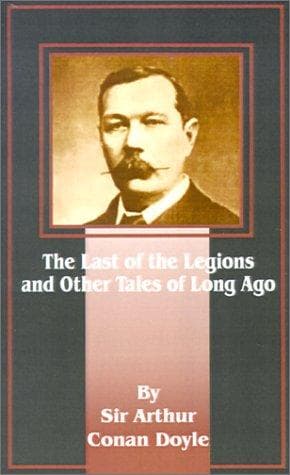
The Last of the Legions and Other Tales of Long AgoDoyle, Arthur Conan
General
The Last of the Legions and Other Tales of Long Ago
Doyle, Arthur Conan
Adventure stories, English; Historical fiction, English; Short stories, English
Alexandria, Antioch, and Constantinople were centres of theological
warfare. The whole north of Africa, too, was rent by the strife of the
Donatists, who upheld their particular schism by iron flails and the
war-cry of "Praise to the Lord!" But minor local controversies sank to
nothing when compared with the huge argument of the Catholic and the
Arian, which rent every village in twain, and divided every household
from the cottage to the palace. The rival doctrines of the Homoousian
and of the Homoiousian, containing metaphysical differences so
attenuated that they could hardly be stated, turned bishop against
bishop and congregation against congregation. The ink of the theologians
and the blood of the fanatics were spilled in floods on either side,
and gentle followers of Christ were horrified to find that their faith
was responsible for such a state of riot and bloodshed as had never yet
disgraced the religious history of the world. Many of the more earnest
among them, shocked and scandalised, slipped away to the Libyan Desert,
or to the solitude of Pontus, there to await in self-denial and prayer
that second coming which was supposed to be at hand. Even in the deserts
they could not escape the echo of the distant strife, and the hermits
themselves scowled fiercely from their dens at passing travellers who
might be contaminated by the doctrines of Athanasius or of Arius.
Such a hermit was Simon Melas, of whom I write. A Trinitarian and a
Catholic, he was shocked by the excesses of the persecution of the
Arians, which could be only matched by the similar outrages with which
these same Arians in the day of their power avenged their treatment on
their brother Christians. Weary of the whole strife, and convinced that
the end of the world was indeed at hand, he left his home in
Constantinople and travelled as far as the Gothic settlements in Dacia,
beyond the Danube, in search of some spot where he might be free from
the never-ending disputes. Still journeying to the north and east, he
crossed the river which we now call the Dniester, and there, finding a
rocky hill rising from an immense plain, he formed a cell near its
summit, and settled himself down to end his life in self-denial and
meditation. There were fish in the stream, the country teemed with game,
and there was an abundance of wild fruits, so that his spiritual
exercises were not unduly interrupted by the search of sustenance for
his mortal frame.
Public-domain text, read in full here on John Shaqi.
Reviews
Reviews
No reviews yet
Be the first to share your thoughts on this work.
Join the Discussion
Join the discussion
Sign in to leave a comment or review.
Sign InorCreate an account