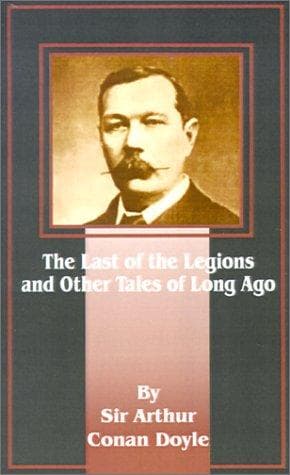
The Last of the Legions and Other Tales of Long AgoDoyle, Arthur Conan
General
The Last of the Legions and Other Tales of Long Ago
Doyle, Arthur Conan
Adventure stories, English; Historical fiction, English; Short stories, English
Now it chanced that there lived in those days a Grecian goatherd named
Policles, who tended and partly owned a great flock which grazed upon
the long flanks of the hills near Herœa, which is five miles north of
the river Alpheus, and no great distance from the famous Olympia. This
person was noted over all the country-side as a man of strange gifts and
singular character. He was a poet who had twice been crowned for his
verses, and he was a musician to whom the use and sound of an instrument
were so natural that one would more easily meet him without his staff
than his harp. Even in his lonely vigils on the winter hills he would
bear it always slung over his shoulder, and would pass the long hours by
its aid, so that it had come to be part of his very self. He was
beautiful also, swarthy and eager, with a head like Adonis, and in
strength there was no one who could compete with him. But all was ruined
by his disposition, which was so masterful that he would brook no
opposition nor contradiction. For this reason he was continually at
enmity with all his neighbours, and in his fits of temper he would
spend months at a time in his stone hut among the mountains, hearing
nothing from the world, and living only for his music and his goats.
One spring morning, in the year of 67, Policles, with the aid of his boy
Dorus, had driven his goats over to a new pasturage which overlooked
from afar the town of Olympia. Gazing down upon it from the mountain,
the shepherd was surprised to see that a portion of the famous
amphitheatre had been roofed in, as though some performance was being
enacted. Living far from the world and from all news, Policles could not
imagine what was afoot, for he was well aware that the Grecian games
were not due for two years to come. Surely some poetic or musical
contest must be proceeding of which he had heard nothing. If so, there
would perhaps be some chance of his gaining the votes of the judges; and
in any case he loved to hear the compositions and admire the execution
of the great minstrels who assembled on such an occasion. Calling to
Dorus, therefore, he left the goats to his charge, and strode swiftly
away, his harp upon his back, to see what was going forward in the
town.
Public-domain text, read in full here on John Shaqi.
Reviews
Reviews
No reviews yet
Be the first to share your thoughts on this work.
Join the Discussion
Join the discussion
Sign in to leave a comment or review.
Sign InorCreate an account