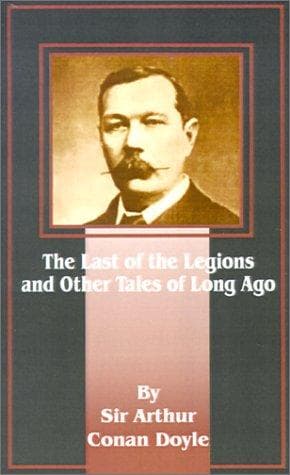
The Last of the Legions and Other Tales of Long AgoDoyle, Arthur Conan
General
The Last of the Legions and Other Tales of Long Ago
Doyle, Arthur Conan
Adventure stories, English; Historical fiction, English; Short stories, English
But what followed filled the shepherd poet with absolute amazement. When
Metas of Corinth had made his bow and withdrawn to half-hearted and
perfunctory applause, there appeared upon the stage, amid the wildest
enthusiasm upon the part of the audience, a most extraordinary figure.
He was a short fat man, neither old nor young, with a bull neck and a
round, heavy face, which hung in creases in front like the dewlap of an
ox. He was absurdly clad in a short blue tunic, braced at the waist with
a golden belt. His neck and part of his chest were exposed, and his
short, fat legs were bare from the buskins below to the middle of his
thighs, which was as far as his tunic extended. In his hair were two
golden wings, and the same upon his heels, after the fashion of the god
Mercury. Behind him walked a negro bearing a harp, and beside him a
richly dressed officer who bore rolls of music. This strange creature
took the harp from the hands of the attendant, and advanced to the front
of the stage, whence he bowed and smiled to the cheering audience. "This
is some foppish singer from Athens," thought Policles to himself, but at
the same time he understood that only a great master of song could
receive such a reception from a Greek audience. This was evidently some
wonderful performer whose reputation had preceded him. Policles settled
down, therefore, and prepared to give his soul up to the music.
The blue-clad player struck several chords upon his lyre, and then
burst suddenly out into the "Ode of Niobe." Policles sat straight up on
his bench and gazed at the stage in amazement. The tune demanded a rapid
transition from a low note to a high, and had been purposely chosen for
this reason. The low note was a grunting, a rumble, the deep discordant
growling of an ill-conditioned dog. Then suddenly the singer threw up
his face, straightened his tubby figure, rose upon his tiptoes, and with
wagging head and scarlet cheeks emitted such a howl as the same dog
might have given had his growl been checked by a kick from his master.
All the while the lyre twanged and thrummed, sometimes in front of and
sometimes behind the voice of the singer. But what amazed Policles most
of all was the effect of this performance upon the audience. Every Greek
was a trained critic, and as unsparing in his hisses as he was lavish in
his applause. Many a singer far better than this absurd fop had been
driven amid execration and abuse from the platform. But now, as the man
stopped and wiped the abundant sweat from his fat face, the whole
assembly burst into a delirium of appreciation. The shepherd held his
hands to his bursting head, and felt that his reason must be leaving
him. It was surely a dreadful musical nightmare, and he would wake soon
and laugh at the remembrance. But no; the figures were real, the faces
were those of his neighbours, the cheers which resounded in his ears
were indeed from an audience which filled the theatre of Olympia. The
Public-domain text, read in full here on John Shaqi.
Reviews
Reviews
No reviews yet
Be the first to share your thoughts on this work.
Join the Discussion
Join the discussion
Sign in to leave a comment or review.
Sign InorCreate an account