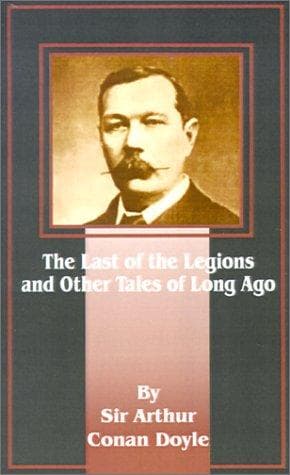
The Last of the Legions and Other Tales of Long AgoDoyle, Arthur Conan
General
The Last of the Legions and Other Tales of Long Ago
Doyle, Arthur Conan
Adventure stories, English; Historical fiction, English; Short stories, English
Well, my dear Crassus, you will have had enough of me and of my Saxons.
I have given you a short sketch of these people and their ways. Since I
began this letter, I have visited the two other ships which have come
in, and as I find the same characteristics among the people on board
them, I cannot doubt that they lie deeply in the race. For the rest,
they are brave, hardy, and very pertinacious in all that they undertake;
whereas the Britons, though a great deal more spirited, have not the
same steadiness of purpose, their quicker imaginations suggesting always
some other course, and their more fiery passions being succeeded by
reaction. When I looked from the deck of the first Saxon ship, and saw
the swaying excited multitude of Britons on the beach, contrasting them
with the intent, silent men who stood beside me, it seemed to me more
than ever dangerous to call in such allies. So strongly did I feel it
that I turned to Kenna, who was also looking towards the beach.
"You will own this island before you have finished," said I.
His eyes sparkled as he gazed. "Perhaps," he cried; and then suddenly
correcting himself and thinking that he had said too much, he added--
"A temporary occupation--nothing more."
VII
AN ICONOCLAST
It was daybreak of a March morning in the year of Christ 92. Outside the
long Semita Alta was already thronged with people, with buyers and
sellers, callers and strollers, for the Romans were so early-rising a
people that many a Patrician preferred to see his clients at six in the
morning. Such was the good republican tradition, still upheld by the
more conservative; but with more modern habits of luxury, a night of
pleasure and banqueting was no uncommon thing. Thus one, who had learned
the new and yet adhered to the old, might find his hours overlap, and
without so much as a pretence of sleep come straight from his night of
debauch into his day of business, turning with heavy wits and an aching
head to that round of formal duties which consumed the life of a Roman
gentleman.
So it was with Emilius Flaccus that March morning. He and his fellow
senator, Caius Balbus, had passed the night in one of those gloomy
drinking bouts to which the Emperor Domitian summoned his chosen friends
at the high palace on the Palatine. Now, having reached the portals of
the house of Flaccus, they stood together under the pomegranate-fringed
portico which fronted the peristyle and, confident in each other's tried
discretion, made up by the freedom of their criticism for the long
self-suppression of that melancholy feast.
"If he would but feed his guests," said Balbus, a little red-faced,
choleric nobleman with yellow-shot angry eyes. "What had we? Upon my
life, I have forgotten. Plovers' eggs, a mess of fish, some bird or
other, and then his eternal apples."
Public-domain text, read in full here on John Shaqi.
Reviews
Reviews
No reviews yet
Be the first to share your thoughts on this work.
Join the Discussion
Join the discussion
Sign in to leave a comment or review.
Sign InorCreate an account