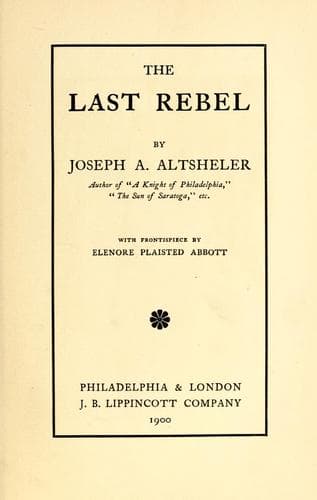
The Last RebelAltsheler, Joseph A. (Joseph Alexander)
History
The Last Rebel
Altsheler, Joseph A. (Joseph Alexander)
Prisoners -- Fiction; United States -- History -- Civil War, 1861-1865 -- Fiction
Lower sank the sun. One edge of the flaming globe disappeared behind
the mountains, and a line of dusk began to creep up under the rim of
the red horizon. It looked like a battle between night and day, with
day losing despite all the power of its ally, the sun. Broader grew the
band of dusk, and narrower became the red segment of the sun. Only the
crest of the mountains, long and sharp like a sword-blade, was in the
light now. There every shrub, every rock, stood out magnified by the
last but most brilliant light of the sinking orb. Beneath this luminous
ribbon, trees, rocks, earth, all were gone. The mountain crests seemed
to swim in the air.
I had seen many sunsets in the mountains, but never before in such a
peculiar situation, and I own that I felt awed. The sun became but
a red fragment; the red leaves and the fiery bubbles on the river
were gone. I could hear the rush of the water, but I could not see
the torrent. I looked up again: the sun, yielding to the night, had
disappeared, leaving but a faint gleam to mark where he had retreated
behind the mountains, to come up again in another place, victorious
in his turn, the next morning. Save for this remembering gleam, the
mountains and the valley were in complete darkness.
It was dark in my room, too, and it was only through accustoming my
eyes to the coming of the night that I was able to see the outlines
of the scanty furniture. My spirits were heavy. I knew nothing of the
nature of the man into whose hands I had fallen, and in these secluded
mountains there was nobody to help me. You can credit, if you will,
much of this feeling to the darkness, which often is a wet blanket upon
the feelings not alone of children, but of grown and experienced men as
well.
It was then with a sensation of relief that I heard some one fumbling
at the door. Any company would be better than none. The door opened,
and the colonel entered, followed by the man who had brought my supper
and a third whom I had not seen before. This new man was of better
dress and presence than Crothers, and the colonel introduced him
briefly.
"Dr. Ambrose, my military surgeon, sir, and a very good one too, I can
assure you."
Crothers put a lighted candle on the table. Dr. Ambrose examined my
swollen ankle. He bound around it a cloth soaked in liniment, and said
it would be well in the morning.
"Now, sir," said the colonel, speaking in a brisk, curt manner, "having
done our duty by you as a disabled prisoner, we will proceed with your
examination. Doctor, it is necessary that this should be taken in
writing. You will kindly act as clerk while I question the prisoner."
I opened my mouth to protest and to demand explanation, but the colonel
cut me short with a "Be silent, sir, until the time comes for you to
speak;" and, rather than be exposed to another such insult, I remained
silent. Moreover, the scene amused me somewhat. I was wondering what
this strange old man would do next.
Public-domain text, read in full here on John Shaqi.
Reviews
Reviews
No reviews yet
Be the first to share your thoughts on this work.
Join the Discussion
Join the discussion
Sign in to leave a comment or review.
Sign InorCreate an account