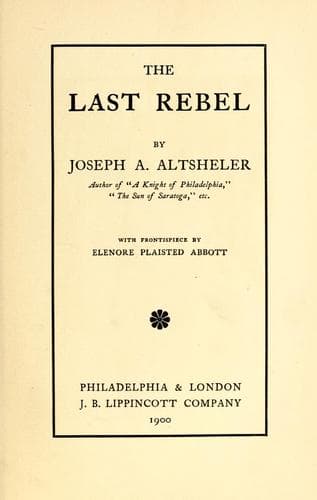
The Last RebelAltsheler, Joseph A. (Joseph Alexander)
History
The Last Rebel
Altsheler, Joseph A. (Joseph Alexander)
Prisoners -- Fiction; United States -- History -- Civil War, 1861-1865 -- Fiction
I saw Crothers looking up at the white, silky clouds: once he shook
his head doubtfully, but I did not ask him his thought. With plenty of
company, the mountains did not impress or awe me as on the night of my
flight. Once our course dipped into a little valley down which a brook
trickled. In the soft earth on either side of it the vigilant Crothers
saw footsteps which he said were those of two men. We knew the two men
must be the doctor and the colonel.
"I should judge from those footprints, though I can't tell precisely,"
said Crothers, "that we haven't gained anything on them."
This was somewhat discouraging, and our enthusiasm did not grow when
the path, after leaving the valley, or rather slit in the hills, led
up a very steep and long slope. Our muscles relaxed under the strain,
and the breath came in irregular puffs. I was very tired, but I was
not willing to own it, especially as I saw Grace walking with still
vigorous step. She had told the truth when she said she was a better
mountaineer than I.
The mists thickened. The moon was but a faint glimmer through them,
and they drifted like lazy clouds. Our world narrowed again, and
instinctively we walked very close together. It was like a fog at sea;
the damp of it carried a raw penetrating chill. There was no wind to
moan or sing through the ravines; the mountains were silent save for
ourselves. Crothers suggested a light, and produced from under his coat
the torch with which he had provided himself in view of such emergency.
It was a long stick, soaked in some compound of tar and turpentine,
and when he lighted one end and held it aloft it burned with energy,
casting a bright, cheerful light.
Nevertheless we shivered in our clothes; the chill in the air was
insistent, and the mist was soaking into the ground and the autumn
foliage. All the world seemed to be a-sweat, and, poor woodsman as I
was, I knew that this had its perils. Pneumonia is not picturesque, but
it is very dangerous.
Crothers looked at me several times as if he expected me to make a
suggestion, but, though by common consent I was the leader of the
party, I waited for him to make it, as he knew more about mountains and
forests than I. But we plodded on for a long time before he spoke. Then
he announced that we must stop for a while and build a fire.
"If we don't," he said, "we'll be soaked through and through with the
cold mist, and in another hour some of us will be shaking with the
chills and fever."
Grace protested against stopping. She was in the greatest alarm lest
a tragedy should happen ahead of us, but, while we felt the same fear,
we recognized also the truth of the old maxim about the futility of too
much haste. I pointed out the dangers to her, and urged that her father
probably had sought shelter somewhere before this. She was compelled
to yield, not to my arguments necessarily, but to her own judgment. I
often think what a jolly world this would be if our judgment and our
wishes were always agreed.
Public-domain text, read in full here on John Shaqi.
Reviews
Reviews
No reviews yet
Be the first to share your thoughts on this work.
Join the Discussion
Join the discussion
Sign in to leave a comment or review.
Sign InorCreate an account