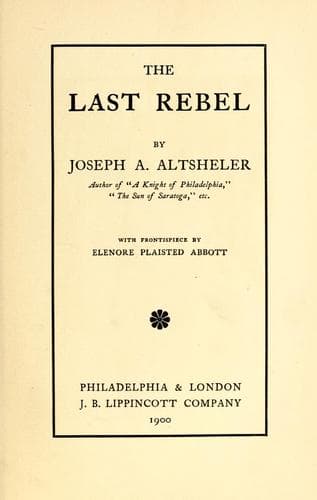
The Last RebelAltsheler, Joseph A. (Joseph Alexander)
History
The Last Rebel
Altsheler, Joseph A. (Joseph Alexander)
Prisoners -- Fiction; United States -- History -- Civil War, 1861-1865 -- Fiction
The smoke rose from the valley, merely a faint spiral of blue, slowly
ascending, and melting so imperceptibly into the clouds that I could
not tell where it ended. Yet there was never a more welcome sight to me
than that little smoky wisp which told so plainly of man's presence.
I pushed on with new zeal, stumbled against a stone, and rose with
an ankle that made bitter complaints. It was not a sprain, but it
was unpleasantly near one, and I doubted my ability to walk with the
cripple over so wicked a way to the valley. I abused the cruelty of
fate, which was but my own carelessness and haste, and then tried to
think out the matter. My first impulse was to throw aside my gun and
escape its weight; that led to my second, which was to fire it in the
hope of attracting attention.
I had plenty of cartridges. I discharged a bullet into the air. The
echo was carried from hill-top to hill-top, until at last I heard it
faintly speeding away through the distant mountains. If any one were
near, such a report could not escape his ears; but the only answer was
the snow, which began to fall as if my shot had been the signal for
its coming. The soft flakes descended gently, but they would soon put
a sheet of white over all the ridges. Some melted on my face, and the
damp chilled me. It was not a time to spare my crippled ankle. I limped
on, firing my rifle a second, third, and fourth time. I could still see
the spiral of smoke, a true beacon to me, though it was all but hid by
the increasing clouds.
I fired the fifth time, and while the echo was yet travelling among the
peaks I heard a faint and very distant halloo. I had no doubt that it
was an answer to my shot, and, to be sure, I emptied a sixth cartridge
into the air. Back came the far cry. Like the shot, it too was taken up
by the echo: ridge repeated it to ridge, faint and far away, until I
could not tell from what point of the compass the true sound had come.
I was perplexed, but hopeful. I believed that help of some kind was
near. I sat down on a rock and expended much ammunition. The snow was
still coming down in the same gentle undecided way, but I was compelled
to stop between shots and brush the damp, white patches off my clothing.
Presently the answering halloo sounded very near me, and I ceased to
fire, replying with a shout.
Two large dogs scampered through the bushes, and, approaching me, began
to bark as if they had brought game to bay. A strong voice ordered them
to be quiet, and then the owner of dogs and voice came into view.
I had expected the usual mountaineer, sallow, angular, and shabby, but
I saw at once that this man was different. The clean-featured, keen,
intelligent face could not belong to one of the ignorant dwellers
in cabins. He was tall, thin, and past sixty, well dressed in a gray
uniform, upon which the brass buttons shone with peculiar brightness.
I had seen such uniforms before, but they were relics, and men do not
often wear them nowadays.
Public-domain text, read in full here on John Shaqi.
Reviews
Reviews
No reviews yet
Be the first to share your thoughts on this work.
Join the Discussion
Join the discussion
Sign in to leave a comment or review.
Sign InorCreate an account