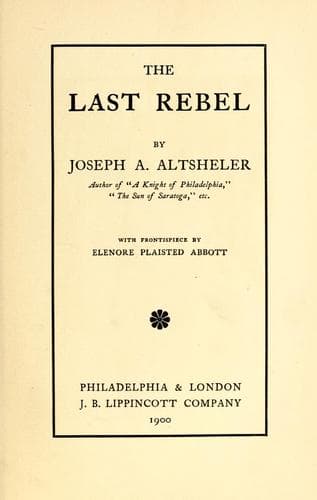
The Last RebelAltsheler, Joseph A. (Joseph Alexander)
History
The Last Rebel
Altsheler, Joseph A. (Joseph Alexander)
Prisoners -- Fiction; United States -- History -- Civil War, 1861-1865 -- Fiction
The end of the day was near, and the night promised to be very cold.
Autumn might be lingering yet in the low-lands, but up here in the
mountains, close to the skies, winter was sovereign. The sun went over
the hills, the whiteness of the earth turned to pallor, and in the dusk
the icy mountains gleamed cheerless and cold. I was very glad that
necessity bade us stay at the hut.
We bestirred ourselves and gathered wood, for we intended to keep
a good fire all night. We assigned Grace to one corner beside the
fireplace, and made a screen for it by hanging up two or three
deerskins. Then we heaped the wood on the fire until the blaze roared
up the chimney. A little window, a mere cut in the logs, a half-foot
square, was left open. When I went out I could see the light of the
fire shining through it, and casting long streaks of red across the
ice, the one friendly beacon in the dreary wilderness.
As the day waned and the night took its place, I began to fear that
it was neither the colonel nor the doctor who had built the fire, or
surely he would have returned before this. After all, it might have
been some stray hunter or mountaineer who had lighted the comfortable
blaze, warmed himself, and passed on, leaving it to serve the same
purpose for any other who might come.
At that point the mountains were more accessible than farther back
toward Fort Defiance. One might penetrate them in several directions
if he were willing to risk falls on the sheet ice. Several of us,
taking our alpenstocks, explored the neighborhood again. The light
was sufficient, the reflection from the ice throwing a kind of pale
glow over everything. But our explorations brought no profit, and, the
night, as we had expected, turning very cold, we returned to the hut.
We stacked our rifles against the wall and composed ourselves for rest.
We did not realize, until the necessity for exertion was over, how
very tired we were. Grace retired to her curtained corner, and in a
few minutes was so still there that we knew she must be asleep despite
anxiety. Some of the soldiers stretched themselves upon the floor, and
they, too, soon slept. Another, sitting upon a stool, with his head
against the wall, snored placidly. We saw no necessity for keeping
watch, and even the vigilant Crothers lay down upon the bench, where
his eyes soon closed and his breathing became long and regular. The
last army of the Confederacy was sound asleep, and the colonel's Yankee
spy alone was awake.
They were old, men mostly, heads gray, almost white, and faces deeply
seamed, like the colonel's. But they looked to me like a loyal lot, and
my sympathy went out to these old fellows, every one of whom I had no
doubt carried old scars on his body. I was sitting on a stone before
the fire, trying to read my fortune in the deep bed of coals. Tiring
of the vain pursuit, I walked to the little window. The old soldiers
slept such a tired and heavy sleep that my footsteps did not disturb
them.
Public-domain text, read in full here on John Shaqi.
Reviews
Reviews
No reviews yet
Be the first to share your thoughts on this work.
Join the Discussion
Join the discussion
Sign in to leave a comment or review.
Sign InorCreate an account