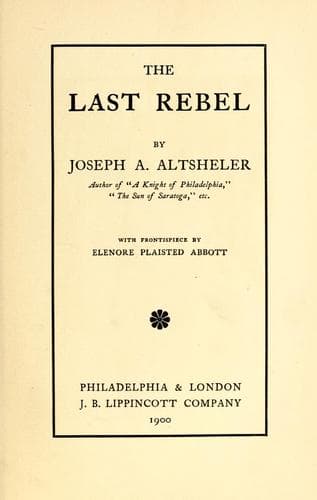
The Last RebelAltsheler, Joseph A. (Joseph Alexander)
History
The Last Rebel
Altsheler, Joseph A. (Joseph Alexander)
Prisoners -- Fiction; United States -- History -- Civil War, 1861-1865 -- Fiction
"Why do you go away, colonel?" I asked. "I am no enemy of yours. I
am your friend. We have come to rescue you from the wilderness. Your
daughter is back there in the hut."
"You are an infernal Yankee spy," he said, "and you are worse than
that; you have turned my people against me."
"Colonel," I said, protesting, "don't delude yourself that way any
longer. The war is over."
"It is not," he said. "All my men may surrender, but I at least will
hold out. Don't I know that they have given up? I saw them in the hut
with you and you were not a prisoner. Keep off, I tell you; do not
come near me."
I was advancing toward him, not with any intent to harm him, instead
the precise reverse, and he, seeing that I would not stop, whipped a
pistol out of his belt and fired at me. I suppose his hand was chilled
by the cold, for the bullet flew wide of me, chipping splinters from
the icy side of a hill. But I stopped, out of regard for my life,
expecting another pistol, and he turned and continued his course into
the higher mountains. I shouted to him to stop, and I shouted to my
comrades in the hut, but the one would not and the others could not
hear. He never looked back, and at last disappeared in a thicket, every
bush of which in the moonlight looked as if it were cast in silver.
I walked back toward the hut, feeling some chagrin over my failure to
keep one of the men for whom we had been looking, after I had found
him. I can say with truth that I was not angered at the colonel's
bullet, as I thought I understood him. The light of the fire was still
shining through the little window, or rather hole in the wall, and
threw a long red bar of light across the whitened earth. It was a
friendly beacon to any man in a normal state of mind.
All the people in the hut were still sound asleep, the snore of some of
the veterans placidly riding the night wind. I took Crothers gently by
the shoulders, and succeeded in waking him without waking any of the
others. Then I led him out of the hut and told him my story. He agreed
with me that it was best not to say anything to Grace of the incident.
But he was in a quandary about the wisest course for us to pursue in
the morning, as the possible paths now led in several directions.
This quandary was ended for the time by the sound of a rifle-shot. We
were so far from expecting anything of the kind that it startled us
both very much. My fear, and I believe that of Crothers was the same,
was lest the colonel and the doctor had met. We knew that the colonel
had taken a rifle with him when he left Fort Defiance, and probably he
had put it in some convenient place near by when he came down to spy us
out in the hut.
"Take this pistol," said Crothers, shoving one into my hand, "but,
remember, Colonel Hetherill must not be harmed."
Public-domain text, read in full here on John Shaqi.
Reviews
Reviews
No reviews yet
Be the first to share your thoughts on this work.
Join the Discussion
Join the discussion
Sign in to leave a comment or review.
Sign InorCreate an account