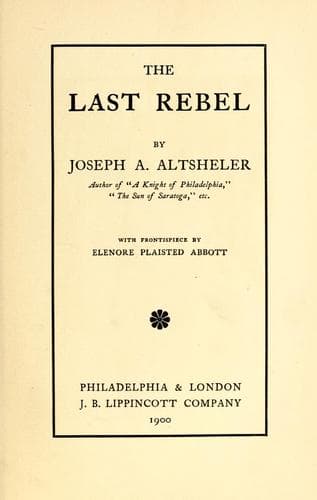
The Last RebelAltsheler, Joseph A. (Joseph Alexander)
History
The Last Rebel
Altsheler, Joseph A. (Joseph Alexander)
Prisoners -- Fiction; United States -- History -- Civil War, 1861-1865 -- Fiction
"Certainly," I said, though secretly wondering.
He seemed to be relieved of his doubts, and, descending the last slope,
we walked at a brisk pace down the valley.
I was surprised at the evidences of care and cultivation, though the
fat, black soil of the valley would justify all the labor that might
be put upon it. The fences were good, the fields well trimmed, and we
soon entered a smooth road. Everything seemed to have the neatness and
precision of the proprietor, the man with whom I was walking. I looked
at him again, and was struck with the evidences of long military habit;
not alone his uniform, but even more decidedly his manner and bearing.
We passed some outhouses built in a better manner than I had seen
elsewhere in the mountain valleys, and approached a large square
building which I knew at first sight to be Fort Defiance, since it
could be nothing else. It was of two stories, made of heavy logs,
unhewn on the outside, the upper story projecting over the lower, after
the fashion of the block-houses of the frontier time. I supposed it to
be some such building, standing here after the lapse of a hundred years
in all its ancient solidity and devoted now to more peaceful uses.
The valley was no less pleasant to eye than to mind. When one is sore
and hungry, mountains lose their picturesqueness and grandeur; a crust
and a bed are infinitely more beautiful, and this valley promised both
and better. The house stood upon a hill which rose to some height and
was shaped like a truncated cone. The little river flowed around three
sides of the hill in a swift, deep current. The fourth side I could
not see, but the three washed at the base by the river were so steep
a man could climb them only with great difficulty. It was a position
of much natural strength, and in the old times, when rifles were the
heaviest weapons used in these regions, it must have been impregnable
except to surprise.
The road we were following curved around and approached the house from
the south side, the side which at first had been hidden from me, and
then I saw it was the only ordinary way by which one could enter Fort
Defiance. But even here art had been brought to the aid of nature. A
wide, deep ditch leading from the river had been carried around the
south side, and the mound was completely encircled by water. We crossed
the ditch on a drawbridge let down by an old man in Confederate gray
like his master, though his was stained and more ancient.
Had the architecture of the fort been different, had it been stone
instead of logs, I could easily have imagined myself back in some
mediæval castle of Europe, and not here in the mountains of Kentucky.
The fort looked very peaceful. Smoke rose from three or four chimneys,
and, drifting, finally united, floating off into the clouds. This was
the lazy coil which I had seen, and which perhaps had saved my life.
Public-domain text, read in full here on John Shaqi.
Reviews
Reviews
No reviews yet
Be the first to share your thoughts on this work.
Join the Discussion
Join the discussion
Sign in to leave a comment or review.
Sign InorCreate an account