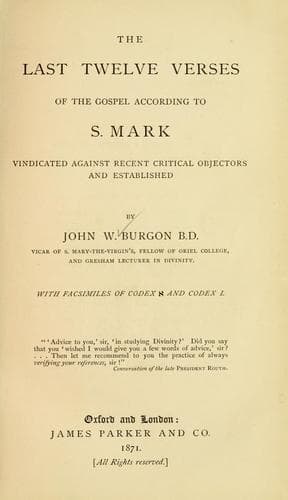
The Last Twelve Verses of the Gospel According to S. MarkBurgon, John William
Religion
The Last Twelve Verses of the Gospel According to S. Mark
Burgon, John William
Bible. Mark XVI, 9-20 -- Criticism, Textual
(2.) That Epiphanius bears no witness whatever either as to the “Sections
of Ammonius” or to “Canons of Eusebius,” Tischendorf is perfectly well
aware. So is my reader.
(3.) His appeal to
CÆSARIUS
is worse than infelicitous. He intends thereby to designate the younger
brother of Gregory of Nazianzus; an eminent physician of Constantinople,
who died A.D. 368; and who, (as far as is known,) _never wrote anything_.
A work called Πεύσεις, (which in the xth century was attributed to
Cæsarius, but concerning which nothing is certainly known except that
Cæsarius was certainly _not_ its author,) is the composition to which
Tischendorf refers. Even the approximate date of this performance,
however, has never been ascertained. And yet, if Tischendorf had
condescended to refer to it, (instead of taking his reference at
second-hand,) he would have seen at a glance that the entire context in
which the supposed testimony is found, _is nothing else but a condensed
paraphrase of that part of Epiphanius_, in which the original statement
occurs.(233)
Thus much, then, for the supposed evidence of AMMONIUS, of EPIPHANIUS, and
of CÆSARIUS on the subject of the last Twelve Verses of S. Mark’s Gospel.
It is exactly _nil_. In fact Pseudo-Cæsarius, so far from “bearing witness
to the fact” that the concluding verses of S. Mark’s Gospel are spurious,
_actually quotes the 16_th_ verse as genuine_.(234)
(4.) As for Eusebius, nothing whatever has been added to what we knew
before concerning his probable estimate of these verses.
IV. We are now at liberty to proceed to the only head of external
testimony which remains undiscussed. I allude to the evidence of
THE CATENÆ.
“In the Catenæ on Mark,” (crisply declares Dr. Davidson,) “there is no
explanation of this section.”(235) “The Catenæ on Mark:” as if they were
quite common things,—“plenty, as blackberries!” But,—_Which_ of “the
Catenæ” may the learned Critic be supposed to have examined?
1. Not the Catena which Possinus found in the library of Charles de
Montchal, Abp. of Toulouse, and which forms the basis of his Catena
published at Rome in 1673; because _that_ Codex is expressly declared by
the learned Editor to be defective from ver. 8 to the end.(236)
2. Not the Catena which Corderius transcribed from the Vatican Library and
communicated to Possinus; because in _that_ Catena the 9th and 12th verses
are distinctly commented on.(237)
3. Still less can Dr. Davidson be thought to have inspected the Catena
commonly ascribed to Victor of Antioch,—which Peltanus published in Latin
in 1580, but which Possinus was the first to publish in Greek (1673). Dr.
Davidson, I say, cannot certainly have examined _that_ Catena; inasmuch as
it contains, (as I have already largely shewn, and, in fact, as every one
may see,) a long and elaborate dissertation on the best way of reconciling
the language of S. Mark in ver. 9 with the language of the other
Evangelists.(238)
Public-domain text, read in full here on John Shaqi.
Reviews
Reviews
No reviews yet
Be the first to share your thoughts on this work.
Elsewhere in the archive
Join the Discussion
Join the discussion
Sign in to leave a comment or review.
Sign InorCreate an account