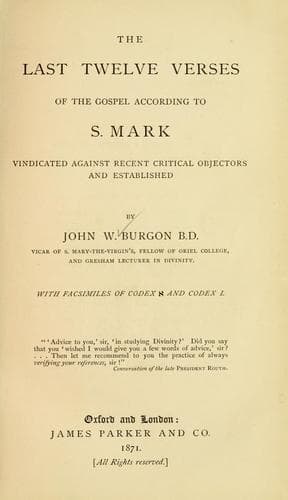
The Last Twelve Verses of the Gospel According to S. MarkBurgon, John William
Religion
The Last Twelve Verses of the Gospel According to S. Mark
Burgon, John William
Bible. Mark XVI, 9-20 -- Criticism, Textual
A distinct class of objections remains to be considered. An argument much
relied on by those who deny or doubt the genuineness of this portion of S.
Mark’s Gospel, is derived from considerations of internal evidence. In the
judgment of a recent Editor of the New Testament,—These twelve verses
“bear traces of _another hand_ from that which has shaped the _diction_
and _construction_ of the rest of the Gospel.”(240) They are therefore “an
addition to the narrative,”—of which “the internal evidence will be found
to preponderate vastly against the authorship of Mark.”—“A difference,”
(says Dr. Tregelles,) “has been remarked, and truly remarked, between _the
phraseology_ of this section and the rest of this Gospel.”—According to
Dr. Davidson,—“The _phraseology and style_ of the section are unfavourable
to its authenticity.” “The characteristic peculiarities which pervade
Mark’s Gospel do not appear in it; but, on the contrary, terms and
expressions,” “phrases and words, are introduced which Mark never uses; or
terms for which he employs others.”(241)—So Meyer,—“With ver. 9, we
suddenly come upon an excerpting process totally different from the
previous mode of narration. The passage contains none of Mark’s
peculiarities (no εὐθέως, no πάλιν, &c, but the baldness and lack of
clearness which mark a compiler;) while in single expressions, it is
altogether contrary to Mark’s manner.”—“There is” (says Professor Norton)
“a difference so great between the use of language in this passage, and
its use in the undisputed portion of Mark’s Gospel, as to furnish strong
reasons for believing the passage not genuine.”—No one, however, has
expressed himself more strongly on this subject than Tischendorf.
“Singula” (he says) “multifariam a Marci ratione abhorrent.”(242)... Here,
then, is something very like a consensus of hostile opinion: although the
terms of the indictment are somewhat vague. Difference of “Diction and
Construction,”—difference of “Phraseology and Style,”—difference of “Terms
and Expressions,”—difference of “Words and Phrases;”—the absence of S.
Mark’s “characteristic peculiarities.” I suppose, however, that all may be
brought under two heads,—(I.) STYLE, and (II.) PHRASEOLOGY: meaning by
“Style” whatever belongs to the Evangelist’s manner; and by “Phraseology”
whatever relates to the words and expressions he has employed. It remains,
therefore, that we now examine the proofs by which it is proposed to
substantiate these confident assertions, and ascertain exactly what they
are worth by constant appeals to the Gospel. Throughout this inquiry, we
have to do not with Opinion but with Fact. The unsupported dicta of
Critics, however distinguished, are entitled to no manner of attention.
1. In the meantime, as might have been expected, these confident and
often-repeated asseverations have been by no means unproductive of
mischievous results:
Like ceaseless droppings, which at last are known
To leave their dint upon the solid stone.
Public-domain text, read in full here on John Shaqi.
Reviews
Reviews
No reviews yet
Be the first to share your thoughts on this work.
Elsewhere in the archive
Join the Discussion
Join the discussion
Sign in to leave a comment or review.
Sign InorCreate an account