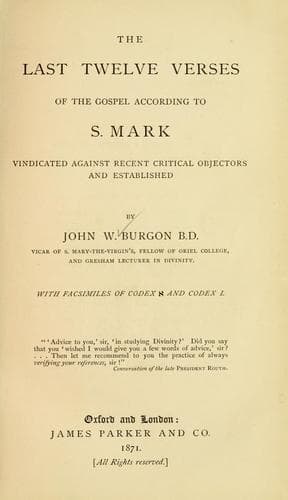
The Last Twelve Verses of the Gospel According to S. MarkBurgon, John William
Religion
The Last Twelve Verses of the Gospel According to S. Mark
Burgon, John William
Bible. Mark XVI, 9-20 -- Criticism, Textual
I observe that Scholars and Divines of the best type (as the Rev. T. S.
Green(243)) at last put up with them. The wisest however reproduce them
under protest, and with apology. The names of Tischendorf and Tregelles,
Meyer and Davidson, command attention. It seems to be thought incredible
that they can _all_ be _entirely_ in the wrong. They impose upon learned
and unlearned readers alike. “Even Barnabas has been carried away with
their dissimulation.” He has (to my surprise and regret) two suggestions:—
(_a_) The one,—That this entire section of the second Gospel may possibly
have been written long after the rest; and that therefore its verbal
peculiarities need not perplex or trouble us. It was, I suppose,
(according to this learned and pious writer,) a kind of after-thought, or
supplement, or Appendix to S. Mark’s Gospel. In this way I have seen the
last Chapter of S. John once and again accounted for.—To which, it ought
to be a sufficient answer to point out that there is _no appearance
whatever_ of any such interval having been interposed between S. Mark xvi.
8 and 9: that it is highly improbable that any such interval occurred: and
that until the “verbal peculiarities” have been ascertained to exist, it
is, to say the least, a gratuitous exercise of the inventive faculty to
discover reasons for their existence. Whether there be not something
radically unsound and wrong in all such conjectures about
“after-thoughts,” “supplements,” “appendices,” and “second editions” when
the everlasting Gospel of JESUS CHRIST is the thing spoken of,—a confusing
of things heavenly with things earthly which must make the Angels weep,—I
forbear to press on the present occasion. It had better perhaps be
discussed at another opportunity. But φίλοι ἄνδρες(244) will forgive my
freedom in having already made my personal sentiment on the subject
sufficiently plain.
(_b_) His other suggestion is,—That this portion may not have been penned
by S. Mark himself after all. By which he clearly means no more than
this,—that as we are content not to know _who_ wrote the conclusion of the
Books of Deuteronomy and Joshua, so, if needful, we may well be content
not to know who wrote the end of the Gospel of S. Mark.—In reply to which,
I have but to say, that after cause has been shewn why we should indeed
believe that not S. Mark but some one else wrote the end of S. Mark’s
Gospel, we shall be perfectly willing to acquiesce in the new fact:—but
_not till then_.
Public-domain text, read in full here on John Shaqi.
Reviews
Reviews
No reviews yet
Be the first to share your thoughts on this work.
Elsewhere in the archive
Join the Discussion
Join the discussion
Sign in to leave a comment or review.
Sign InorCreate an account