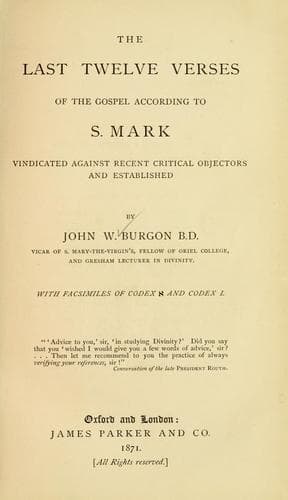
The Last Twelve Verses of the Gospel According to S. MarkBurgon, John William
Religion
The Last Twelve Verses of the Gospel According to S. Mark
Burgon, John William
Bible. Mark XVI, 9-20 -- Criticism, Textual
4. How utterly insecure must be every approximation to such a method of
judging about the Authorship of any twelve verses of Scripture which can
be named, scarcely requires illustration. The attentive reader of S.
Matthew’s Gospel is aware that a mode of expression which is _six times
repeated_ in his viiith and ixth chapters is perhaps only once met with
besides in his Gospel,—viz. in his xxist chapter.(248) The “style” of the
17th verse of his ist chapter may be thought unlike anything else in S.
Matthew. S. Luke’s five opening verses are unique, both in respect of
manner and of matter. S. John also in his five opening verses seems to me
to have adopted a method which is not recognisable anywhere else in his
writings; “rising strangely by degrees,” (as Bp. Pearson expresses
it,(249)) “making the last word of the former sentence the first of that
which followeth.”—“_He_ knoweth that he saith true,” is the language of
the same Evangelist concerning himself in chap. xix. 35. But, “_we_ know
that his testimony is true,” is his phrase in chap. xxi. 24. Twice, and
twice only throughout his Gospel, (viz. in chap. xix. 35: xx. 31), is he
observed to address his readers, and on both occasions in the same words:
(“that _ye_ may believe.”) But what of all this? Is it to be supposed that
S. Matthew, S. Luke, S. John are not the authors of those several places?
From facts like these no inference whatever is to be drawn as to the
genuineness or the spuriousness of a writing. It is quite to mistake the
Critic’s vocation to imagine that he is qualified, or called upon, to pass
any judgment of the sort.
5. I have not said all this, of course, as declining the proposed
investigation. I approach it on the contrary right willingly, being
confident that it can be attended by only one result. With what is true,
endless are the harmonies which evolve themselves: from what is false, the
true is equally certain to stand out divergent.(250) And we all desire
nothing but the Truth.
I. To begin then with the “STYLE AND MANNER” of S. Mark in this place.
1. We are assured that “instead of the _graphic, detailed_ description by
which this Evangelist is distinguished, we meet with an abrupt,
sententious manner, resembling that of brief notices extracted from larger
accounts and loosely linked together.”(251) Surely if this be so, the only
lawful inference would be that S. Mark, in this place, _has_ “extracted
brief notices from larger accounts, and loosely linked them together:” and
unless such a proceeding on the part of the Evangelist be judged
incredible, it is hard to see what is the force of the adverse criticism,
as directed against the _genuineness_ of the passage now under
consideration.
Public-domain text, read in full here on John Shaqi.
Reviews
Reviews
No reviews yet
Be the first to share your thoughts on this work.
Elsewhere in the archive
Join the Discussion
Join the discussion
Sign in to leave a comment or review.
Sign InorCreate an account