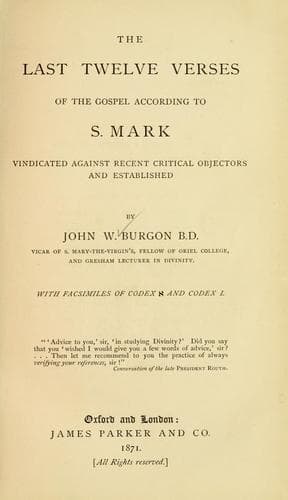
The Last Twelve Verses of the Gospel According to S. MarkBurgon, John William
Religion
The Last Twelve Verses of the Gospel According to S. Mark
Burgon, John William
Bible. Mark XVI, 9-20 -- Criticism, Textual
2. True indeed it is that here and there a voice has been lifted up in the
way of protest(245) against the proposed inference from the familiar
premisses; (for the self-same statements have now been so often
reproduced, that the eye grows weary at last of the ever-recurring string
of offending vocables:)—but, with _one_ honorable exception,(246) men do
not seem to have ever thought of calling the premisses themselves in
question: examining the statements one by one: contesting the ground inch
by inch: refusing absolutely to submit to any dictation whatever in this
behalf: insisting on bringing the whole matter to the test of severe
inquiry, and making every detail the subject of strict judicial
investigation. This is what I propose to do in the course of the present
Chapter. I altogether deny the validity of the inference which has been
drawn from “the style,” “the phraseology,” “the diction” of the present
section of the Gospel. But I do more. I entirely deny the accuracy of
almost _every individual statement_ from which the unfavourable induction
is made, and the hostile inference drawn. Even _this_ will not nearly
satisfy me. I insist that one only result can attend the exact analysis of
this portion of the Gospel into its elements; namely, a profound
conviction that S. Mark is most certainly its Author.
3. Let me however distinctly declare beforehand that remarks on “the
style” of an Evangelist are singularly apt to be fallacious, especially
when (as here) it is proposed to apply them to a very limited portion of
the sacred narrative. Altogether to be mistrusted moreover are they, when
(as on the present occasion) it is proposed to make them the ground for
possibly rejecting such a portion of Scripture as spurious. It becomes a
fatal objection to such reasoning that _the style_ may indeed be
exceedingly diverse, and yet _the Author_ be confessedly one and the same.
How exceedingly dissimilar in style are the Revelation of S. John and the
Gospel of S. John! Moreover, practically, the promised remarks on “style,”
when the Authorship of some portion of Scripture is to be discussed, are
commonly observed to degenerate at once into what is really quite a
different thing. Single words, perhaps some short phrase, is appealed to,
which (it is said) does not recur in any part of the same book; and thence
it is argued that the Author can no longer be the same. “According to this
argument, _the recurrence of the same words_ constitutes identity of
style; the want of such recurrence implies difference of style;—difference
of style in such a sense as compels us to infer diversity of authorship.
Each writer is supposed to have at his disposal a limited number of
‘formulæ’ within the range of which he must work. He must in each chapter
employ these formulæ, and these only. He must be content with one small
portion of his mother-tongue, and not dare to venture across the limits of
that portion,—on pain of losing his identity.”(247)
Public-domain text, read in full here on John Shaqi.
Reviews
Reviews
No reviews yet
Be the first to share your thoughts on this work.
Elsewhere in the archive
Join the Discussion
Join the discussion
Sign in to leave a comment or review.
Sign InorCreate an account